Analytics initiatives often promise insight, speed, and smarter decisions. Executive teams, however, still ask one question before approval: What is the return? This article explains analytics ROI calculation from an enterprise perspective, shows how to apply the ROI formula to data and cloud initiatives, and outlines practical methods to connect analytics investments to revenue growth, cost savings, and long-term operational value.
Why Analytics ROI Calculation Matters at the Enterprise Level
Analytics budgets face scrutiny because outcomes feel abstract. Dashboards look impressive, yet boards expect financial proof. Analytics ROI calculation closes this gap by translating data initiatives into measurable business value.
Within the first hundred days of most analytics programs, leaders expect clarity on ROI meaning, total costs, and the return on investment definition. Without a clear ROI calculation formula, analytics risk classification is seen as a cost center rather than a revenue driver.
Enterprises that master analytics ROI calculation gain three advantages: better capital allocation, executive confidence, and long-term data strategy alignment.
From my experience with enterprise analytics programs, the difference between success and budget cuts often comes down to how clearly ROI is defined and communicated.
What Is ROI in Business Analytics?
Return on investment, often abbreviated as ROI, represents the financial gain or loss relative to total investment cost. In analytics contexts, ROI extends beyond revenue alone.
ROI meaning in analytics includes revenue generation, operational cost reduction, hours saved, risk reduction, and customer satisfaction improvement.
The standard ROI definition appears simple, yet analytics adds nuance because benefits span tangible and intangible areas.
ROI Formula Explained for Analytics
The core ROI equation remains consistent across industries.
| ROI Formula Component | Description |
| Net Benefit | Revenue growth + cost savings – total costs |
| Total Costs | Technology, licenses, cloud services, labor, data integration |
| ROI Formula | (Net Benefit ÷ Total Costs) × 100 |
This return on investment formula provides a percentage that executives understand quickly. Analytics ROI calculation relies on this equation, with careful attention to benefit attribution.
Analytics ROI Calculation vs Traditional ROI Models
Traditional ROI models suit capital assets such as equipment or real estate. Analytics ROI calculation requires a broader lens.
| Dimension | Traditional ROI | Analytics ROI |
| Value Horizon | Short to mid-term | Long term |
| Benefit Type | Direct revenue | Revenue growth plus cost savings |
| Measurement Style | Static | Data driven |
| Intangibles | Rare | Core component |
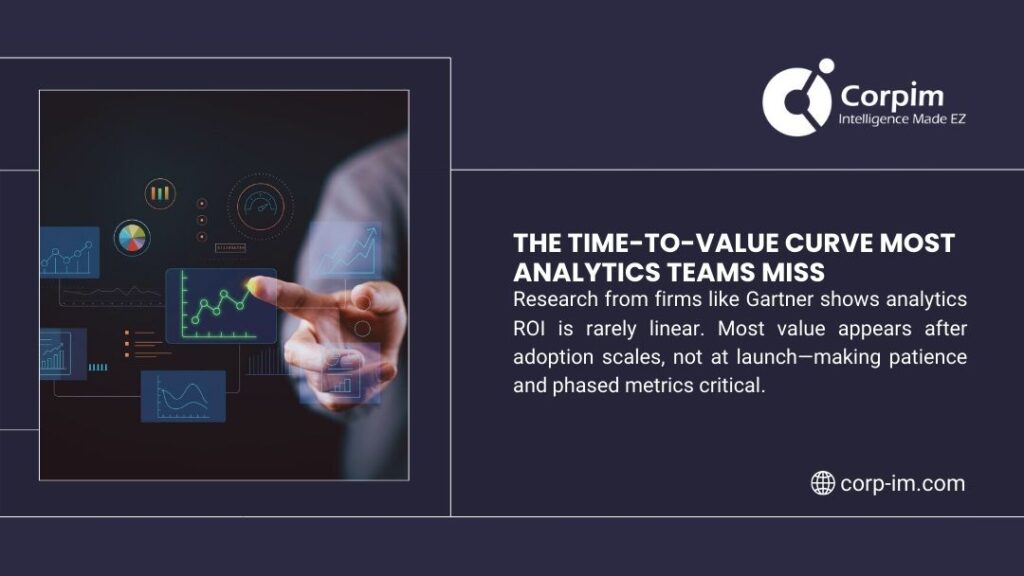
Analytics initiatives often deliver compound value over time. Early phases show operational efficiency gains. Later phases unlock strategic insight and competitive advantage.

The Hidden Costs That Distort Analytics ROI Calculation
Many organizations underestimate total costs, which weakens ROI credibility. Accurate analytics ROI calculation requires full cost visibility.
| Cost Category | Typical Oversight |
| Data Integration | API work and legacy system connection |
| Cloud Infrastructure | Scaling and storage growth |
| Governance | Security, compliance, access control |
| Adoption | Training, change management |
Ignoring these elements leads to inflated ROI estimates that collapse under executive review. Organizations that modernize data architecture through structured programs, such as data systems modernization, often reduce hidden costs significantly over time.
How Analytics ROI Calculation Links to Business Intelligence Strategy
Analytics does not exist in isolation. It supports broader business intelligence initiatives that guide operational and strategic decisions. Enterprises that connect analytics ROI calculation to a defined business intelligence strategy gain stronger results because analytics serves business goals rather than technology goals. A clear BI strategy ensures every analytics metric ties back to revenue, cost control, or risk mitigation.
Measuring Revenue Growth From Analytics
Revenue attribution remains the most persuasive ROI metric. Analytics influences revenue through pricing optimization, demand forecasting, and customer segmentation.
| Revenue Driver | Analytics Impact |
| Sales Forecast Accuracy | Higher close rates |
| Customer Retention | Reduced churn |
| Cross-Sell Opportunity | Higher average deal value |
Analytics ROI calculation links these outcomes to financial metrics, which strengthens executive confidence. Industries such as automotive retail benefit heavily from analytics-driven KPI tracking.
Cost Savings and Operational Efficiency Metrics
Cost reduction often delivers faster ROI than revenue growth. Analytics uncovers inefficiencies across supply chains, finance operations, and service delivery.
| Cost Area | Analytics Benefit |
| Manual Reporting | Hours saved |
| Data Errors | Lower rework cost |
| Infrastructure | Optimized cloud spend |
Organizations that adopt structured business intelligence reporting frameworks often document measurable savings within months.
Analytics ROI Calculation Across Cloud Models
Cloud architecture choices influence ROI significantly. Each model affects scalability, compliance, and cost structure.
| Cloud Model | ROI Characteristics |
| Public Cloud | Fast scale, variable cost |
| Private Cloud | Predictable cost, compliance strength |
| Hybrid Cloud | Balance of control and flexibility |
Enterprises with regulated workloads often favor private cloud computing solutions, while analytics experimentation fits well in public cloud computing environments. Hybrid strategies bridge both needs.
Enterprise Performance Management and Analytics ROI
Enterprise performance management (EPM) systems translate analytics into planning, forecasting, and accountability. Analytics ROI calculation improves when EPM platforms unify financial and operational data.
| EPM Capability | ROI Contribution |
| Budget Accuracy | Reduced variance |
| Forecast Confidence | Better capital allocation |
| Scenario Analysis | Risk avoidance |
Corpim’s EPM expertise helps enterprises connect analytics insight to financial outcomes.
Industry-Specific Analytics ROI Examples
Analytics ROI varies by industry due to the complexity of data and regulatory demands.
| Industry | ROI Focus |
| Financial Services | Risk reduction, compliance |
| Healthcare | Cost control, outcome quality |
| Manufacturing | Yield improvement, downtime reduction |
| Insurance | Claims efficiency |
Corpim supports industry-specific analytics through business intelligence consulting services.
Measuring Intangible Value Without Guesswork
Intangible benefits often derail ROI discussions. Analytics ROI calculation can still capture these elements with proxy metrics.
| Intangible Benefit | Proxy Metric |
| Customer Satisfaction | Retention rate |
| Decision Speed | Cycle time |
| Risk Reduction | Incident frequency |
When tied to financial impact, these metrics enhance the credibility of ROI.
Analytics ROI Calculation Best Practices for Executives
| Practice | Business Impact |
| Define ROI early | Clear expectations |
| Track baseline metrics | Accurate comparison |
| Review quarterly | Continuous improvement |
| Align to strategy | Executive buy-in |
Analytics programs that follow these practices maintain executive trust and long-term funding.
Why Corpim Fits Analytics ROI-Driven Enterprises
Corpim supports analytics programs with a strong focus on measurable outcomes. With more than 25 years of enterprise experience, Corpim aligns data architecture, cloud strategy, and performance management to support reliable analytics ROI calculation. Their approach emphasizes long-term value rather than short-term dashboards.
FAQs
How long does it take to see analytics ROI?
Most organizations see early ROI within 3–6 months, especially from:
- Reduced reporting effort
- Faster access to trusted data
- Fewer errors from manual processes
Full analytics ROI calculation often stabilizes between 12 and 18 months, once adoption spreads across departments.
Why do analytics ROI calculations fail?
Common failure points include:
- Incomplete cost tracking
- Weak data governance
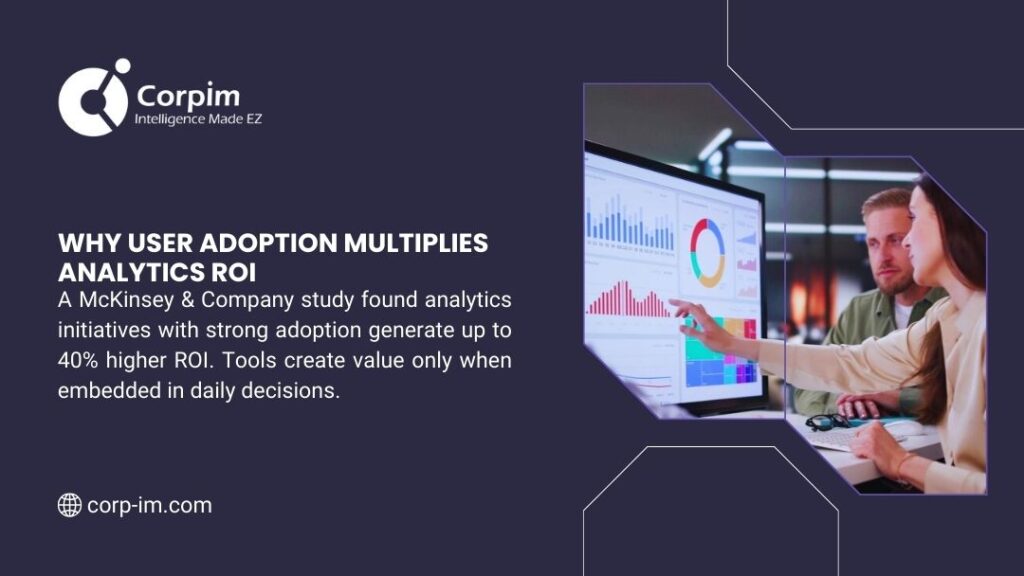
- Low user adoption
- No baseline metrics before launch
Analytics ROI calculation works best when paired with a clear analytics strategy and executive sponsorship.
Is analytics ROI calculation a percentage?
Yes. Analytics ROI calculation produces a percentage value, showing how much return the organization gains relative to the total investment. For example, if analytics delivers $500,000 in net benefit on $250,000 in cost, ROI = 200%.
How do you measure analytics ROI without revenue impact?
When revenue impact stays indirect, analytics ROI calculation focuses on cost savings, productivity gains, and risk reduction. Examples include fewer hours spent on reporting, lower error rates, and improved compliance outcomes. These benefits still produce measurable financial value.
Why is analytics ROI hard to measure?
Analytics benefits often include intangible gains such as decision speed and risk reduction, which require proxy metrics.
Final Takeaway
Analytics ROI calculation transforms analytics from a cost discussion into a value conversation. Enterprises that connect analytics to business intelligence strategy, cloud architecture, and performance management gain measurable returns and sustained executive trust. With the right structure, analytics delivers proof, not promises.