BI total cost of ownership usually dictates whether an analytics rollout generates real value or turns into a massive sinkhole for capital. Sticker prices for licenses tell only a sliver of the actual tale. Elements like infrastructure, data integration, rigid governance, user onboarding, and daily maintenance define the true spending profile as years pass.
This guide clarifies what BI total cost of ownership entails for large organizations, how to map it out precisely, and how modern, cloud-first frameworks slash these burdens without hurting scale or regulatory compliance.
What Is BI Total Cost of Ownership?
BI total cost of ownership is the full financial weight an organization carries when adopting an analytics tool over its entire operational life. This idea reaches far past the initial subscription fee. It mirrors the complex spending layers that appear as the BI platform scales across different departments, messy data sources, and vital decision-making workflows.
In real-world enterprise terms, this includes the software itself, the underlying compute power, the sweat equity required to clean and move data, and the relentless operational work needed to keep reports trusted and secure.
It also catches “hidden” drains like internal staff time, system downtime, slow decisions, and the technical debt left behind by shortcuts. For leaders, it acts as a financial lens that bridges tech investments with long-term ROI.
Why BI Total Cost of Ownership Deserves Executive Attention
Within the initial hundred days of launching a BI platform, initial budget forecasts frequently start to wobble. The entry price might seem fine, but ownership overhead spikes as data pipelines grow, user counts climb, and regulatory heat intensifies. BI total cost of ownership isn’t just a purchase price; it is the comprehensive financial burden of a solution throughout its active life.
For the modern CIO, CTO, or CFO, this metric ties technical spending to concrete business results. It answers a blunt question: what is the actual cost to keep this analytics engine running for three to five years? In heavy enterprise environments, ignoring this leads to sloppy capital planning, “shadow IT” tools popping up everywhere, and analytics programs that eventually hit a wall.
BI Total Cost of Ownership vs. BI Pricing
BI pricing is simply what the vendor bills you for access. BI total cost of ownership is what you actually pay to operate and depend on that software. This gap becomes a chasm as BI moves from a small pilot team to a global enterprise standard.
While pricing highlights visible fees, TCO unearths “buried” costs like cloud consumption, integration maintenance, and the heavy lift of security governance. Two tools with identical licensing can have wildly different TCO footprints once you factor in operational complexity and scale.
| Aspect | BI Pricing | BI Total Cost of Ownership |
| Focus | Vendor fees and licensing | Full lifecycle financial impact |
| Time Horizon | Short‑term | Three to five years |
| Cost Visibility | High at purchase | Fully visible over time |
| Infrastructure Impact | Often excluded | Fully included |
| Integration Effort | Rarely reflected | Major cost driver |
| Operational Overhead | Usually ignored | Central component |
Smart leaders use this distinction to avoid budgeting traps and pick solutions that fit their actual long-term financial reality.
Core Cost Categories That Shape BI Total Cost of Ownership
1. Software and Platform Costs
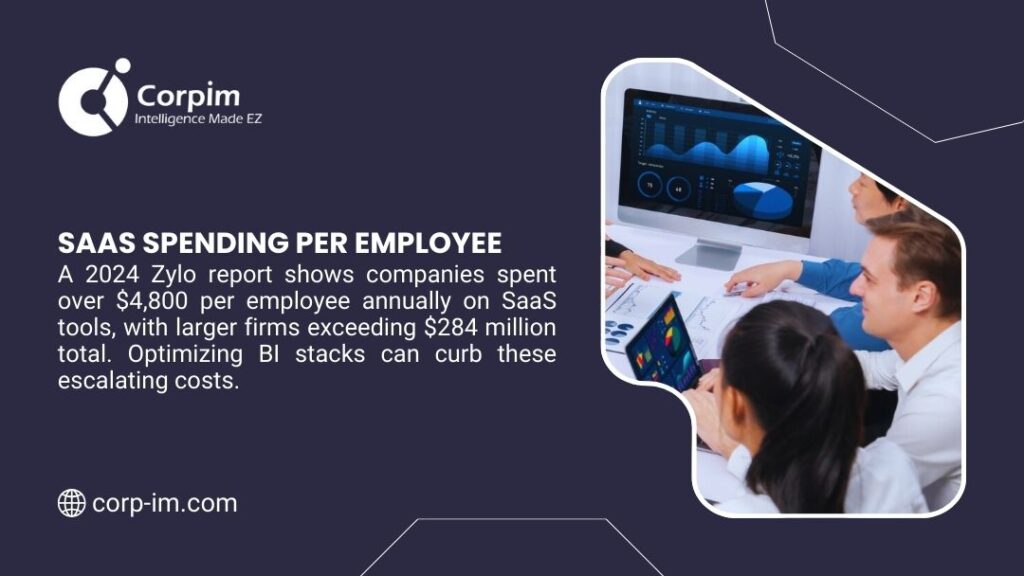
Direct software expenses involve more than just a base license; they include tiered subscriptions and necessary upgrades. Within the SaaS BI ecosystem, “pay-per-use” models frequently inflate TCO as the volume of dashboards, complex queries, and automated data refreshes climbs.
Enterprise-grade solutions featuring modular architectures typically slash ownership costs by mapping specific features to genuine business requirements, avoiding the waste of “all-in-one” licensing traps.Note: These pricing frameworks align tightly with the strategic approaches utilized across broader business intelligence services.
2. Infrastructure and Cloud Computing Costs
Hardware and hosting represent a massive chunk of the BI TCO pie. Deciding between public, private, hybrid, or multi-cloud environments dictates the predictability of your long-term budget.
| Cloud Model | Cost Predictability | Scalability | Governance Control | Typical TCO Profile |
| Public Cloud | Medium | High | Moderate | Low entry bar; variable long‑term costs |
| Private Cloud | High | Medium | High | Stiffer initial spend; stable ownership |
| Hybrid Cloud | High | High | High | Highly balanced total cost of ownership |
Corpim’s technical consultants frequently champion hybrid frameworks for organizations handling regulated data or high-performance workloads that demand strict cost management alongside massive scale.
3. Data Integration and Pipeline Architecture
Data plumbing generates massive indirect costs that rarely show up in a vendor’s initial pitch. Fragile data pipeline architectures drive up TCO through constant manual monitoring, error patching, and resolution efforts.
Modernizing these legacy systems cuts ownership overhead by swapping out brittle connections for standardized APIs and cloud-native flows. Streamlining these pipelines reduces the labor tax on your analytics and boosts system reliability.
4. Governance, Security, and Compliance
Compliance mandates hit the bottom line directly. Managing role-based access, keeping audit trails, and handling encryption adds layers of operational friction if these aren’t baked into the platform from day one.
Heavily regulated fields, think healthcare, insurance, or banking, face much higher ownership costs when their governance remains fragmented. Transitioning to cloud-native security helps stabilize long-term TCO by unifying controls.
5. Operations, Support, and Administration
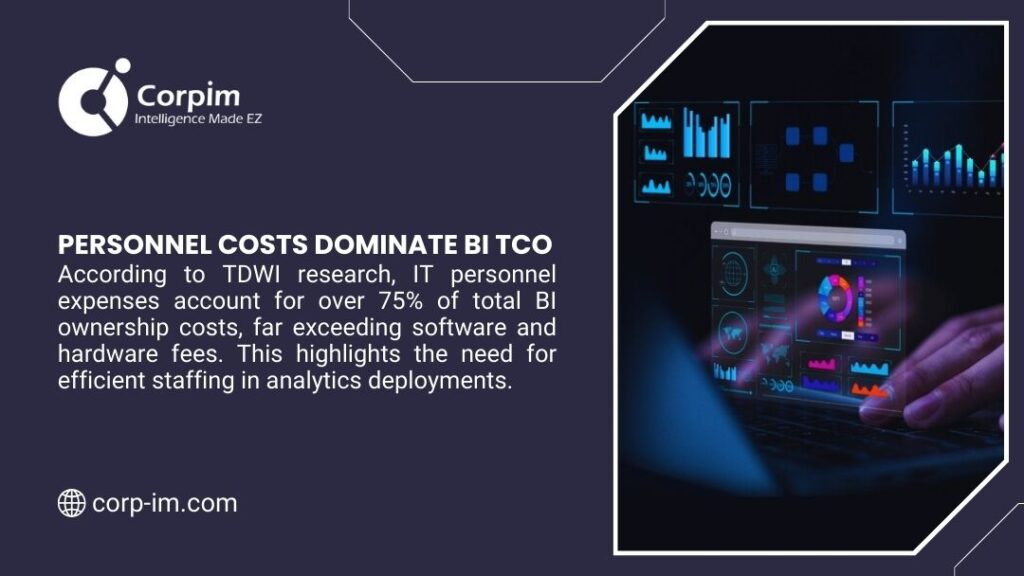
Managing the platform day-to-day often costs more than the software itself. Patching, scaling, and general administration require expensive human capital. BI tools that prioritize automation and managed service hooks lower TCO by decreasing the organization’s reliance on hard-to-find analytics engineers. Corpim’s professional services bridge this gap by offering high-level architecture leadership and virtual CIO support.
6. User Adoption and Analytics ROI
Poor adoption is a silent budget killer. When dashboards lack relevance or trust, they become shelfware, incurring full platform costs with zero business return. A focused BI strategy, combined with standardized reporting and role-specific views, ensures that your investment actually generates ROI rather than just adding to the total ownership bill.
How to Calculate BI Total Cost of Ownership
Determining a realistic TCO requires a comprehensive financial lens that tracks every dollar across the entire BI lifecycle. Standard enterprise evaluations typically span a three-to-five-year window. This timeframe is essential to capture the nuances of user growth, data expansion, and evolving security needs.
The calculation starts by mapping every cost component: software, hosting, integration labor, support staff, and administration. These figures are then projected forward, adjusted for the inevitable surge in data volume and reporting complexity.
The standard BI total cost of ownership formula is expressed as:
BI Total Cost of Ownership = Software Costs + Infrastructure Costs + Data Integration Costs + Operations and Support Costs + Governance and Compliance Costs + Indirect Business Costs
This equation serves as a strategic framework rather than a rigid number. Success depends on using honest assumptions, disciplined data gathering, and tight collaboration between IT, Finance, and business leaders.
Sample BI TCO Cost Model
A visual cost model allows decision-makers to track how ownership expenses shift over time. Typically, the first year is heavy on integration and setup, while later years reflect the steady state of hosting and operations.
Below is a typical three-year TCO model for an enterprise-level BI platform:
| Cost Category | Year 1 | Year 2 | Year 3 | Three‑Year Total |
| Software Costs | $120k | $130k | $140k | $390k |
| Infrastructure | $90k | $110k | $130k | $330k |
| Data Integration | $150k | $60k | $40k | $250k |
| Operations and Support | $80k | $90k | $100k | $270k |
| Total Ownership Cost | $440k | $390k | $410k | $1.24M |
This breakdown highlights how heavy lifting in Year 1, like cleaning data pipelines, lowers the ownership tax in subsequent years. Organizations prioritizing scalable cloud platforms and clean data flows generally see a much more favorable TCO over time.
How Modern BI Architectures Reduce Total Cost of Ownership
Cloud‑Native BI and Predictable Cost of Ownership
Cloud‑native BI platforms reduce BI total cost of ownership by aligning consumption with actual usage. Elastic infrastructure limits over‑provisioning while governance frameworks maintain control.
Corpim’s cloud computing emphasizes predictable cost of ownership through right‑sized architectures rather than unchecked scalability.
Enterprise Performance Management and BI TCO
Enterprise performance management platforms consolidate planning, reporting, and analytics into a single governed environment. This consolidation reduces redundant tools and lowers ownership costs.
Within enterprise performance management solutions, BI becomes part of a broader financial and operational framework rather than a disconnected reporting layer.
Industry‑Specific BI Platforms
Industry‑specific BI solutions reduce total cost of ownership by eliminating customization overhead. In automotive operations provides standardized analytics, automation, and reporting aligned with franchise workflows.
Similar patterns apply across financial services, healthcare, insurance, and manufacturing, where tailored BI reduces ownership cost and accelerates value.
Common BI Total Cost of Ownership Pitfalls
BI initiatives fail to meet financial expectations when ownership costs receive limited attention during planning. Many enterprises focus on licensing decisions while overlooking the structural factors that drive long‑term TCO.
The table below outlines frequent BI total cost of ownership pitfalls and their financial impact.
| Pitfall | Impact on BI Total Cost of Ownership |
| License‑driven tool selection | High operational and integration costs |
| Underestimated data complexity | Increased support and maintenance effort |
| Fragmented analytics tools | Duplicate infrastructure and reporting costs |
| Weak governance model | Higher compliance and security expenses |
| Low user adoption | Ownership cost without business return |
Avoiding these pitfalls requires a disciplined BI strategy that aligns architecture, governance, and business outcomes from the start. Enterprises that evaluate BI total cost of ownership early reduce financial risk and build analytics platforms that remain sustainable as data demands grow.
Strategic Takeaways for Enterprise Leaders
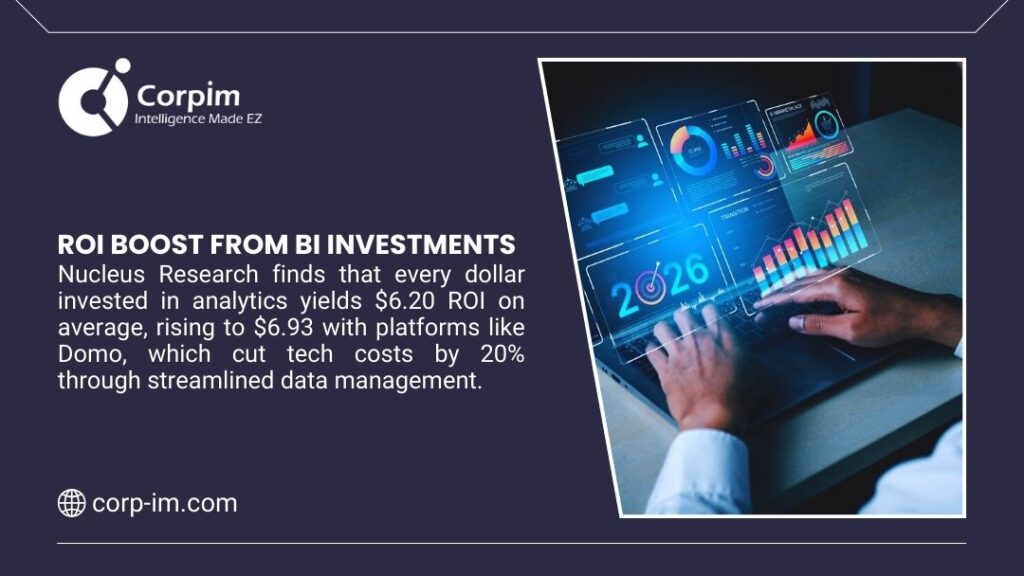
TCO offers a grounded reality check for analytics spending. Leaders who weigh total ownership against expected ROI end up with much more durable technology stacks. Corpim’s focus on modernization and architecture reflects a deep understanding of how to keep these costs sustainable as an organization grows.
FAQs
How does cloud computing affect BI TCO?
Cloud computing improves cost predictability and scalability, often lowering long‑term ownership costs when paired with proper governance and architecture design.
How long should enterprises measure BI total cost of ownership?
Most organizations assess BI TCO over three to five years to capture growth, upgrades, and operational costs.
Why does user adoption influence ownership cost?
Low adoption increases ownership cost because platforms incur expenses without delivering measurable business value.
Can industry‑specific BI reduce total cost to own?
Yes. Industry‑specific BI platforms reduce customization, support effort, and integration costs, improving overall ownership efficiency.
Closing Perspective
BI total cost of ownership shines a light on the real math behind analytics. Treating BI as a core strategic platform, rather than just another piece of software, leads to leaner budgets, tighter security, and better long-term returns.