Business intelligence ROI separates useful analytics programs from expensive reporting exercises. This guide explains how enterprises calculate business intelligence ROI, reduce analytics waste, strengthen governance, and connect BI investment to financial outcomes. We also outline how modern cloud platforms, enterprise performance frameworks, and disciplined data strategy convert analytics spend into sustained business value.
Business Intelligence ROI Starts With Business Reality, Not Dashboards
Business intelligence ROI remains the number-one question from CIOs, CFOs, and operations leaders after analytics investment approval. The reason stays simple: dashboards look impressive, yet budget pressure demands proof. Executives no longer accept vanity metrics or vague insight claims. They want cost clarity, revenue impact, and operational improvement tied directly to data systems.
Within the first hundred days of most BI programs, cracks appear. Reports multiply. Adoption stalls. Data disputes rise. ROI stays unclear. This pattern repeats across financial services, healthcare, automotive, and manufacturing sectors.
True business intelligence ROI emerges only after organizations connect analytics output to financial decisions, operational action, and governance discipline. From a data architecture perspective, value appears when BI aligns with enterprise goals rather than tool features.
Organizations that treat BI as a long-term capability rather than a reporting task see measurable gains across cost control, risk reduction, and growth strategy.
Why Most Enterprises Struggle to Prove Business Intelligence ROI
1. Analytics Focus Without Financial Context
Many BI programs emphasize visualization quality rather than decision impact. Leaders see charts yet lack answers to cost variance, margin erosion, or customer churn. Without a financial context, analytics fail to justify spend.
Early adoption often prioritizes tools over outcomes. BI platforms ship quickly, yet business rules, ownership, and usage models remain vague.
2. Weak Business Intelligence Governance
Poor business intelligence governance erodes trust. Multiple data definitions, spreadsheet shadow systems, and manual overrides undermine confidence. When executives doubt numbers, analytics loses authority.
Strong governance frameworks assign ownership, validation rules, and audit paths across enterprise data assets. Governance protects ROI by preventing decision errors and compliance exposure.
3. Legacy Infrastructure Bottlenecks
On-prem data silos limit agility. Queries take hours. Integration costs rise. Cloud adoption stalls due to security concerns or an unclear migration path. Legacy systems inflate the BI total cost of ownership while reducing flexibility.
Modern enterprises shift toward hybrid or multi-cloud platforms with scalable compute and unified data layers.
How Business Intelligence ROI Actually Gets Measured
Core Metrics That Matter
Effective measuring BI success requires clarity across three categories:
| ROI Category | Example Metrics |
| Financial | Cost reduction, margin lift, revenue attribution |
| Operational | Cycle time reduction, automation rate |
| Risk | Compliance exposure reduction, audit effort |
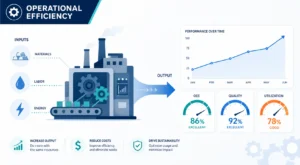
Analytics ROI calculation fails when teams focus only on usage metrics such as report views or login counts. Value emerges after tying analytics output to business action. Our guide to operational efficiency metrics that prove business impact covers the specific KPIs — cycle time, automation rate, throughput — that link analytics investment to measurable results.
Cost of Bad Data Decisions
The cost of bad data decisions often exceeds analytics platform by orders of magnitude. Inaccurate forecasting, delayed response, or compliance penalties carry real financial damage. Executives now evaluate BI ROI through avoided loss, not only incremental gain.

Business Intelligence ROI and Enterprise Cloud Strategy
Cloud Models and ROI Impact
| Cloud Model | ROI Advantage | Common Use |
| Public | Elastic scale, cost transparency | Analytics burst demand |
| Private | Security control, compliance | Regulated data |
| Hybrid | Flexibility, cost balance | Enterprise BI |
| Multi-Cloud | Vendor resilience | Global operations |
Enterprises that align BI with the right cloud model reduce infrastructure waste and improve performance predictability. For many, hybrid cloud computing provides the best balance of control and scale.
Strategic cloud computing adoption also supports faster analytics cycles and lower capital expense.
Data Modernization as the Foundation of BI ROI
Without modern data architecture, BI platforms fail to scale. Legacy systems restrict access, increase integration cost, and slow analytics cycles. A strong data pipeline architecture unifies ingestion, transformation, and delivery across systems. Well-designed pipelines reduce manual effort and improve trust.
Enterprises that follow data pipeline architecture best practices achieve faster insight delivery and stronger governance enforcement. Platforms such as Databricks play a role in unified analytics and AI readiness. Understanding what Databricks helps leaders align architecture choice with ROI targets.
Business Intelligence ROI Across Industry Use Cases
Automotive and Retail Operations
Automotive enterprises keep a close eye on labor efficiency, inventory turnover, and service margins because those metrics reveal how well the operation is really running. When KPIs are tracked accurately, pricing decisions tighten up, and day-to-day throughput becomes easier to manage. A clear understanding of what a KPI means in the automotive industry helps reinforce more structured, data-driven analytics across the business.
Financial Services
Banks and insurers rely on analytics for risk exposure, fraud detection, and regulatory compliance. BI ROI here ties directly to loss prevention and reporting efficiency. AI in financial services strengthens predictive insight and scenario analysis.
Healthcare
Healthcare organizations focus on cost control, patient flow, and compliance reporting. Strong data governance improves audit readiness and reimbursement accuracy.
Manufacturing
Manufacturers link BI to throughput, downtime, and quality metrics. Enterprise analytics improves demand planning and supply coordination.

Business Intelligence Strategy That Protects ROI
A sustainable business intelligence strategy aligns data architecture, governance, and executive ownership. Strategy defines:
- Decision ownership
- Metric accountability
- Platform scope
- Adoption expectations
This approach prevents tool sprawl and metric confusion. Enterprises often confuse business intelligence vs data analytics. BI focuses on descriptive and diagnostic insight. Analytics extends into predictive and prescriptive domains. Clear distinction protects ROI expectations.
AI, Automation, and Business Intelligence ROI
AI adoption within BI accelerates insight speed and pattern detection. AI in business intelligence improves forecasting accuracy and anomaly detection without manual effort. However, AI success depends on data quality and governance maturity. Without a disciplined structure, AI amplifies error.
AI forecasting tools support demand planning and financial projection across industries. Enterprises also explore AI tools for business across reporting, forecasting, and scenario modeling.
SharePoint ROI and Enterprise Reporting
Many organizations rely on SharePoint for document and report distribution. SharePoint ROI improves when BI output integrates seamlessly with collaboration workflows. Centralized access reduces email distribution, version conflict, and audit risk.
Enterprise Performance Management and BI ROI
Enterprise performance management connects BI insight with planning and forecasting cycles. Strong EPM frameworks close the loop between analytics and action. When BI feeds EPM systems, enterprises gain:
- Budget accountability
- Forecast accuracy
- Scenario clarity
Corpim enterprise performance management services support integrated planning and analytics maturity.
Consulting Models That Improve Business Intelligence ROI
Internal teams often lack time or architecture depth for enterprise BI transformation. Business intelligence consulting fills skill gaps across design, governance, and execution.
Specialized consulting models exist for enterprise, emerging companies, and SMB segments. Sector-specific consulting for insurance, healthcare, manufacturing, and financial services addresses regulatory nuance and operational reality. Corpim professional services provide architecture leadership and execution discipline across BI programs.
FAQs
How long does it take to realize business intelligence ROI?
Most enterprises see measurable return within 6–12 months after governance alignment and adoption discipline.
What drives BI’s total cost of ownership?
Infrastructure, integration effort, licensing, and support models shape BI’s total cost of ownership.
Does BI ROI require AI?
No. AI improves insight speed, yet core ROI depends on data quality and decision alignment.
Which cloud model supports BI ROI best?
Hybrid cloud fits most enterprises due to the flexibility and compliance balance.
Can small enterprises achieve BI ROI?
Yes. Right-sized platforms and focused metrics support ROI even at SMB scale.

Final Takeaway
Business intelligence ROI does not come from dashboards alone. It results from a disciplined data strategy, modern cloud architecture, governance structure, and leadership accountability. Enterprises that treat BI as a decision system rather than a reporting tool protect investment and gain sustained advantage. Organizations that seek measurable analytics value benefit most from partners with deep data architecture experience, industry insight, and long-term delivery focus, qualities that define Corpim’s approach to enterprise BI and cloud modernization.