The financial drain tied to poor data decisions rarely hits a balance sheet as a single, identifiable charge. Instead, this silent tax compounds through flawed market forecasts, hesitant leadership, customer attrition, legal exposure, and massive amounts of wasted manpower.
As modern enterprises lean more heavily on real-time streams, predictive analytics, and autonomous systems, the risk of low-quality data scales exponentially. This analysis explores how fractured information sets erode corporate trust, disrupt the rhythm of operations, and weaken long-term strategy, while highlighting how governance and cloud architecture can plug these financial leaks.
The Cost of Bad Data Decisions Starts With Trust: Then Erodes It
Every data-centric organization operates on a fundamental premise: that the numbers populating their dashboards actually mirror reality. Trust in these figures is the bedrock of strategic pivots, operational roadmaps, and high-stakes financial planning. However, this confidence doesn’t usually vanish overnight; it bleeds out slowly as data quality starts to slide.
The fallout from poor data choices often begins with minor, almost invisible glitches. A revenue figure might show a slight variance between two internal systems. A key customer profile misses a recent update. A scheduled report refresh lags by a few hours.
While these seem like trivial hurdles, they eventually poison the well. Leaders begin to doubt their tools, teams spend more energy scrubbing numbers than executing on them, and the window for seizing market opportunities begins to close.
According to Gartner, poor data quality siphons an average of $12.9 million annually from organizations, a figure largely driven by constant rework and missed chances. As firms accelerate their use of AI and automated workflows, that number climbs; flawed data simply travels faster and breaks more things at once in a connected environment.
Once that internal trust in the system of record is broken, the costs compound. Rather than acting as a compass for growth, data becomes a hurdle that employees learn to work around rather than rely upon.
What Counts as Bad Data in Enterprise Environments
In the context of a large enterprise, bad data isn’t always a glaring error or a typo. More often, it manifests as information that is technically correct but functionally useless, incomplete, stagnant, or stripped of its vital context. When a single customer identity exists in four different systems with slight variations, it creates a distorted view of the truth. When financial metrics are calculated using conflicting assumptions across different departments, the result is a set of competing narratives that stall progress.
As companies expand, their information footprints scatter across hybrid clouds, legacy on-premise servers, and various third-party apps. Without a unified definition of truth, these systems naturally drift apart.
Human intervention, often in the form of manual spreadsheet fixes, only deepens the inaccuracy. Over time, many organizations simply accept this friction as a cost of doing business, failing to realize it is a direct driver of poor decision-making.
Research suggests that roughly 30% of business data is inaccurate or lacking critical detail. This level of systemic unreliability makes real-time analysis a gamble and forces high-value employees to spend their days correcting errors instead of driving innovation.
The Cost of Bad Data Decisions Across Core Business Functions
The damage caused by low-quality data is rarely siloed in one department. Because data flows through an organization like a current, an error at the source eventually shocks the entire system. We can see the true price of these bad decisions by looking at how specific teams struggle when their information foundations are weak.
Financial Planning and Forecast Risk
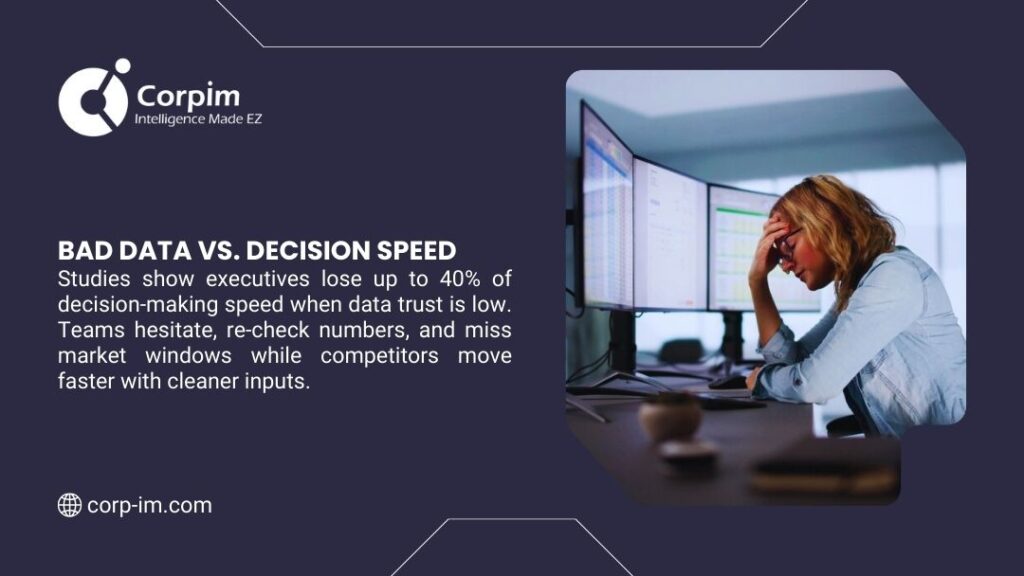
Precision is the lifeblood of finance. When planning teams work with corrupted inputs, revenue projections drift away from reality, budgets lose their teeth, and capital is allocated to the wrong initiatives. Even a tiny percentage of error can evolve into a massive material risk once it is compounded across several quarterly planning cycles.
For global enterprises that rely on agile, rolling forecasts, inaccurate data introduces a level of volatility that executives find impossible to justify or control. When enterprise performance tools aggregate data from shaky sources, they don’t fix the errors; they amplify them.
Operations and Resource Waste
On the operational front, bad data translates directly into wasted physical and human resources. Inventory models based on stale numbers lead to expensive overages or catastrophic stockouts. Workforce scheduling misses the mark on peak demand. Maintenance cycles fail because they aren’t synced with the actual wear and tear of the equipment.
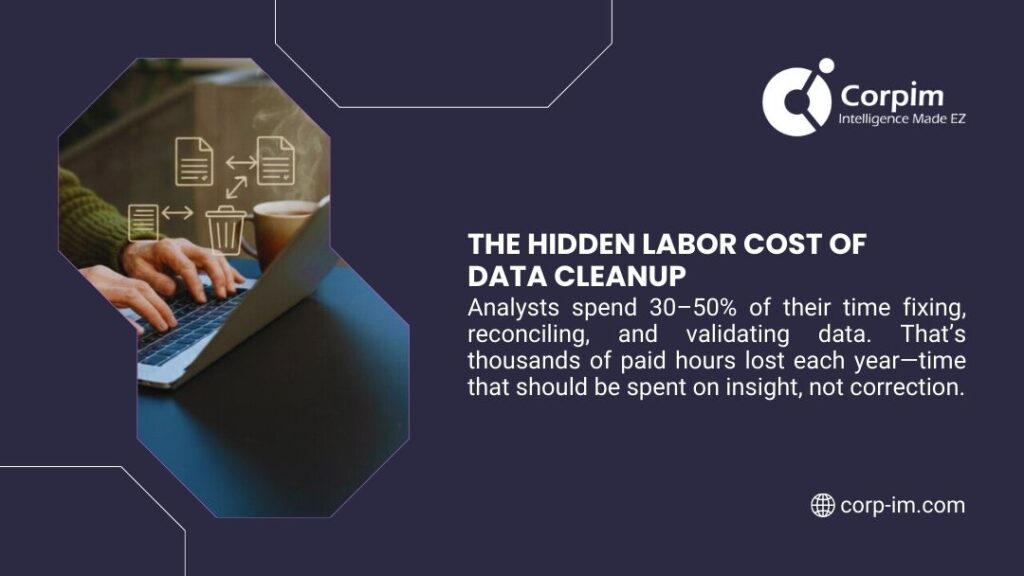
Research indicates that data-driven firms can lose as much as 15-25% of their total annual revenue due to operational lags tied to poor data and delayed insights. A significant portion of this loss is simply the cost of boring administrative rework, reconciling mismatched reports, and chasing down errors.
Without real-time visibility, the cost of bad data becomes a permanent anchor on an organization’s performance.
Customer Experience and Revenue Leakage
Errors in customer data hit the bottom line fast. Incorrect contact info, outdated purchase histories, and fragmented profiles lead to botched marketing and frustrated clients. Personalization, the holy grail of modern sales, is impossible if the underlying data lacks integrity.
Data shows that 88% of buyers prioritize the experience as much as the product itself, yet fragmented data remains the primary reason these experiences fail. Revenue leakage happens when a company cannot see a customer’s full history or respond to their needs in the proper context.
In customer-facing roles, the price of bad data is often felt as churn, which is far harder to fix than a simple accounting error.
Why Legacy Systems Multiply the Cost of Poor Data Quality
Old systems rarely just stop working; they linger as technical debt. They carry rigid schemas and outdated logic that were never meant to play nice with modern cloud tools. When a business tries to layer advanced analytics on top of these aging foundations, the inconsistencies don’t go away; they multiply.
Legacy data often lacks the validation and metadata required for modern transparency. Integration usually involves custom duct-tape scripts or manual exports that invite human error. Over time, teams build complex workarounds that hide the real issues rather than solving them at the source.
This fragmentation makes it nearly impossible to trace a bad number back to its origin. When leadership starts questioning the reports, the lack of clarity further erodes trust and grinds the decision-making process to a halt.
Cloud Architecture as a Data Risk Control Mechanism
A well-designed cloud architecture acts as a safety net for data integrity. Modern platforms allow for automated validation checks and centralized controls that catch bad data before it can do damage further down the line.
Public clouds offer speed, while private clouds offer high-level control. Hybrid models seek to balance both, letting companies modernize their most sensitive data at their own pace.
| Cloud Model | Data Control | Cost Profile | Risk Exposure |
| Public cloud computing | Shared governance | Lower entry cost | Medium |
| Private cloud computing | High control | Predictable | Low |
| Hybrid cloud computing | Balanced | Optimized | Low to medium |
However, the cloud isn’t a magic fix. Without a solid governance strategy, a company just moves its existing data problems into a faster environment, allowing bad decisions to happen at a higher frequency.
The Role of Data Governance in Strategic Decision Accuracy
Governance is about creating a clear line of accountability for every piece of data. It establishes sources of truth and ensures that everyone is using the same definitions for the same KPIs.
Without this structure, different departments end up with conflicting metrics. C-suite meetings devolve into arguments over whose spreadsheet is more correct rather than discussing the actual business strategy.
Organizations with high data maturity can spot errors early, significantly reducing the long-term price of bad data. Governance doesn’t have to slow things down; in fact, it provides the stable foundation needed for AI and advanced analytics to actually work.
Business Intelligence as a Cost Containment Strategy
BI tools are more than just a way to make charts; they are an essential cost-control mechanism. When reports are designed well, they surface outliers and anomalies before those errors can infect a major strategic decision.
Effective BI reduces the hours spent checking the numbers and boosts the confidence of the people making the calls. Organizations that align their BI tools with specific business outcomes see much less rework and fewer redundant technology costs over time.
Instead of just being a rear-view mirror, BI serves as a defensive shield against financial and operational risk.
AI, Machine Learning, and the Multiplier Effect of Bad Data
AI and machine learning have a multiplier effect on data quality issues. If a model is trained on biased or messy data, it will produce incorrect outputs with high confidence, essentially automating poor decision-making at scale.
Studies found that many AI initiatives fail to deliver a return on investment, primarily because the data foundation is too weak. When automated systems are fed garbage, the errors spread through the company much faster than any manual process ever could. This makes cleaning up the data foundation a prerequisite for any serious automation or AI project.
Industry-Specific Risk Profiles
The cost of bad data is universal, but how that cost manifests depends heavily on the industry.
- Automotive: Dealers and manufacturers lose 2% to 4% in profit due to inventory errors and demand planning delays.
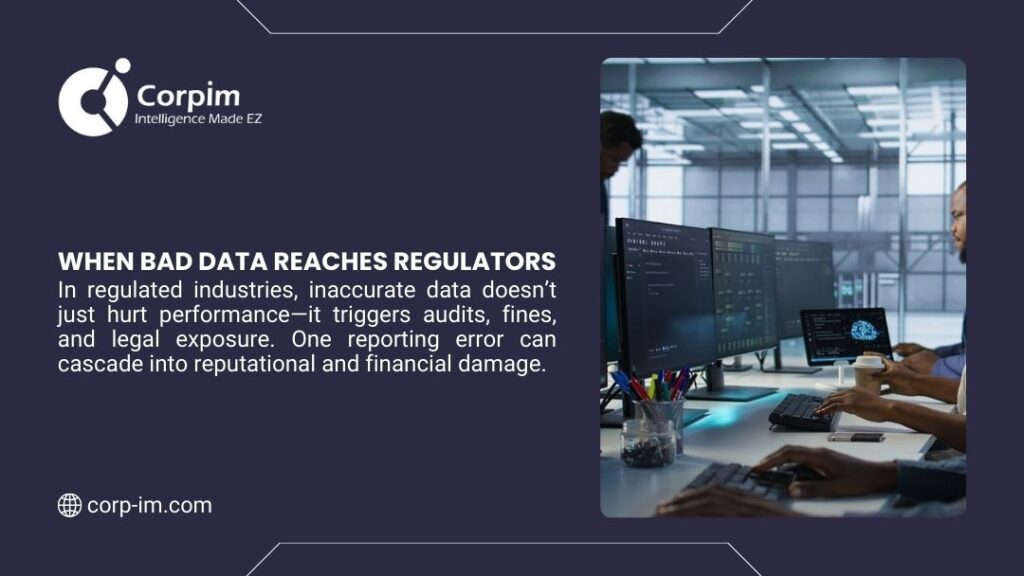
- Financial Services: Accuracy isn’t just a goal; it’s a legal requirement. Bad data here triggers massive fines and distorts risk models.
- Healthcare: Poor data interoperability leads to administrative waste and, more importantly, delayed patient care.
- Insurance: Inconsistent records lead to “leaky” claims processing and incorrectly priced policies.
- Manufacturing: Data gaps are responsible for nearly 5-20% of unplanned downtime, as maintenance is reactive rather than predictive.
Where Corpim Fits Without the Sales Pitch
Tackling the cost of bad data requires more than just a new software subscription; it requires architectural clarity. Corpim helps enterprises navigate this transition by modernizing systems and aligning cloud strategies with real-world governance.
With 25 years of experience across sectors like automotive and healthcare, Corpim focuses on simplifying complex data environments. Their goal is to build trusted foundations that allow for BI and AI success without the hidden risks of poor data quality.
FAQs
What is the cost of bad data decisions?
It involves direct financial loss, wasted employee time, legal risks, and the loss of customer and internal trust.
Why does bad data persist in modern organizations?
Mainly due to siloed systems, a lack of clear data ownership, and “technical debt” from legacy platforms.
Does cloud adoption eliminate bad data?
No. The cloud provides the tools to manage data better, but you still need governance and quality rules in place.
How does business intelligence reduce data-related costs?
By acting as an early-warning system that catches inconsistencies before they affect the big-picture strategy.
When should organizations address data quality issues?
The best time is now, specifically before you invest in AI, machine learning, or automated scaling.