Data cleansing for BI plays a central role in shaping accurate analytics, reliable reporting, and confident business decisions. Organizations that rely on fragmented or inconsistent data often struggle to extract meaningful insights, even with advanced BI tools in place. This guide explains how enterprises approach data cleansing, why it matters for modern analytics ecosystems, and how structured data strategies support long-term digital transformation goals.
Data Cleansing for BI: Why Clean Data Shapes Enterprise Decisions
Data cleansing for BI defines the reliability of every dashboard, report, and predictive model within an organization. When data enters systems in an inconsistent or incomplete state, even the most advanced analytics platforms produce distorted outcomes.
Across enterprise environments, leadership teams often assume that BI tools alone guarantee insight. In reality, the quality of underlying datasets determines whether insights reflect reality or create risk. Clean data supports transparency, while poor-quality data introduces uncertainty into strategic planning.
Organizations that invest in structured analytics often explore foundational capabilities such as business intelligence to align data, reporting, and decision-making into a single framework.
What Is Data Cleansing?
Data cleansing refers to the systematic refinement of datasets so they meet standards of accuracy, consistency, and completeness. Instead of a one-time correction, it reflects a continuous discipline that evolves with data growth.
Within enterprise environments, data originates from multiple systems such as ERP platforms, CRM tools, financial systems, and external sources. Each source introduces variations in structure, format, and quality. Data cleansing resolves these inconsistencies and prepares datasets for analytical use.
| Element | Description |
| Raw Data | Unprocessed data collected from multiple systems |
| Clean Data | Verified, structured, and standardized data |
| Data Validation | Process of confirming accuracy and consistency |
| Data Standardization | Alignment of formats and structures across datasets |
When integrated into reporting systems like business intelligence reporting, clean datasets provide a stable foundation for decision-making.
Why Data Cleansing for BI Matters
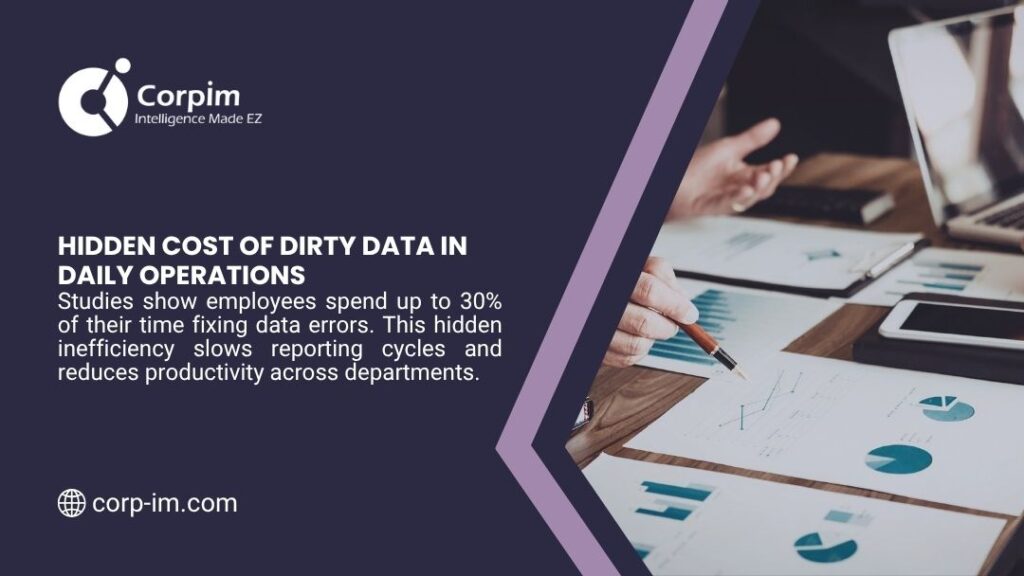
The importance of data cleansing becomes clear when organizations evaluate how data quality affects outcomes across departments. Without a structured approach, reporting errors multiply, and operational inefficiencies increase.
| Impact Area | Effect of Clean Data | Effect of Poor Data |
| Decision Accuracy | Reliable insights for leadership | Misleading conclusions |
| Reporting | Consistent and trustworthy dashboards | Conflicting reports |
| Operations | Efficient workflows | Process delays |
| Compliance | Easier regulatory alignment | Increased audit risks |
A well-defined business intelligence strategy often includes data quality frameworks as a core component, ensuring that analytics efforts align with long-term business goals.
Common Data Quality Issues in BI Systems
Data issues rarely appear in isolation. They often accumulate across systems and processes, creating complex challenges that affect reporting accuracy.
| Issue Category | Example | Business Impact |
| Duplicate Records | Multiple entries for the same customer | Inflated metrics |
| Missing Values | Incomplete transaction data | Gaps in reporting |
| Format Inconsistency | Mixed date formats | Data integration issues |
| Outdated Data | Old customer information | Poor targeting decisions |
| Data Silos | Isolated systems | Lack of unified visibility |
Many of these issues originate from weak integration layers or fragmented architectures. Strong data pipeline architecture helps reduce such inconsistencies over time.
Data Cleansing Process: Step-by-Step
A structured data cleansing process involves several stages that refine datasets step by step. Each stage contributes to improved data reliability.
| Stage | Purpose | Outcome |
| Data Profiling | Identify anomalies and inconsistencies | Clear understanding of data quality |
| Standardization | Align formats and structures | Consistent datasets |
| Deduplication | Remove repeated records | Unique data entries |
| Validation | Verify accuracy against rules | Reliable data |
| Enrichment | Add contextual information | Enhanced datasets |
| Monitoring | Track ongoing data quality | Sustained data accuracy |
Organizations that follow structured processes often align them with business intelligence best practices to maintain consistency across analytics systems.
Data Cleansing Techniques for Enterprise BI
Enterprises apply different techniques depending on data complexity, scale, and business requirements. These techniques often evolve alongside analytics maturity.
| Technique | Description | Use Case |
| Rule-Based Cleansing | Applies predefined validation rules | Structured datasets |
| Statistical Analysis | Detects anomalies and outliers | Large datasets |
| AI-Based Methods | Uses machine learning models | Complex data environments |
| Data Transformation | Converts data into structured formats | BI tool compatibility |
The adoption of advanced techniques has increased with the rise of AI in business intelligence, where automation supports large-scale data refinement.
Data Cleansing for BI in Cloud Environments
Cloud adoption has changed how organizations approach data cleansing. Instead of relying solely on on-premise systems, enterprises now process data across distributed environments.
| Cloud Model | Role in Data Cleansing |
| Public Cloud | Provides scalability for large datasets |
| Private Cloud | Supports secure data environments |
| Hybrid Cloud | Balances flexibility and control |
Organizations exploring cloud-based analytics often review solutions such as cloud computing and its variations, like public cloud computing, private cloud computing, and hybrid cloud computing.
Enterprise Data Cleansing Tools
Modern enterprises rely on a combination of tools to maintain data quality across systems.
| Tool Type | Function |
| ETL Platforms | Extract, transform, and load data |
| Data Integration Tools | Connect multiple data sources |
| BI Platforms | Analyze, visualize, and prepare data for reporting |
| AI Tools | Automate data correction processes |
Platforms associated with big data analytics provide scalable environments for handling large datasets across industries.
Data Cleansing in Enterprise Performance Management
In Enterprise Performance Management (EPM), data quality directly affects how accurately a business can plan, forecast, and evaluate performance. Financial models, budgeting cycles, and executive dashboards all depend on consistent and trustworthy data coming from multiple systems such as ERP, CRM, and operational platforms.
When data is not properly cleansed, even small inconsistencies can distort financial reports or create gaps in performance tracking. For example, duplicate entries or mismatched formats across departments can lead to conflicting numbers in executive summaries, which slows down decision-making and reduces confidence in reporting.
From an enterprise perspective, data cleansing ensures that all inputs feeding into EPM systems are aligned, standardized, and validated before they reach reporting layers. This is especially important in complex environments where organizations operate across multiple regions, systems, or business units.
Companies like Corpim focus on aligning data architecture with business goals, so that EPM systems do not just report numbers but reflect a single, accurate version of the truth. Clean data allows leadership teams to trust forecasts, compare performance across periods, and respond quickly to changes in the market.
Industry Applications of Data Cleansing for BI
Across enterprise environments, data cleansing does not follow a single pattern. Each industry handles different data volumes, structures, and regulatory pressures. As a result, the way organizations apply data cleansing for BI depends heavily on operational needs, system complexity, and reporting expectations.
| Industry | Application |
| Automotive Industry | Multi-location data alignment across service centers to maintain accurate KPI tracking and operational visibility |
| Financial Services | Data validation for risk modeling, compliance reporting, and transaction accuracy |
| Healthcare | Patient record consistency across systems to support clinical and administrative decisions |
| Insurance | Claims and policy data refinement to improve underwriting accuracy and reporting clarity |
| Manufacturing | Supply chain data alignment to support production planning and performance tracking |
In practice, organizations that operate across multiple regions or systems often face overlapping data challenges. Consistent data cleansing frameworks help unify reporting across departments and create a reliable foundation for business intelligence initiatives.
Data Cleansing vs Data Cleaning
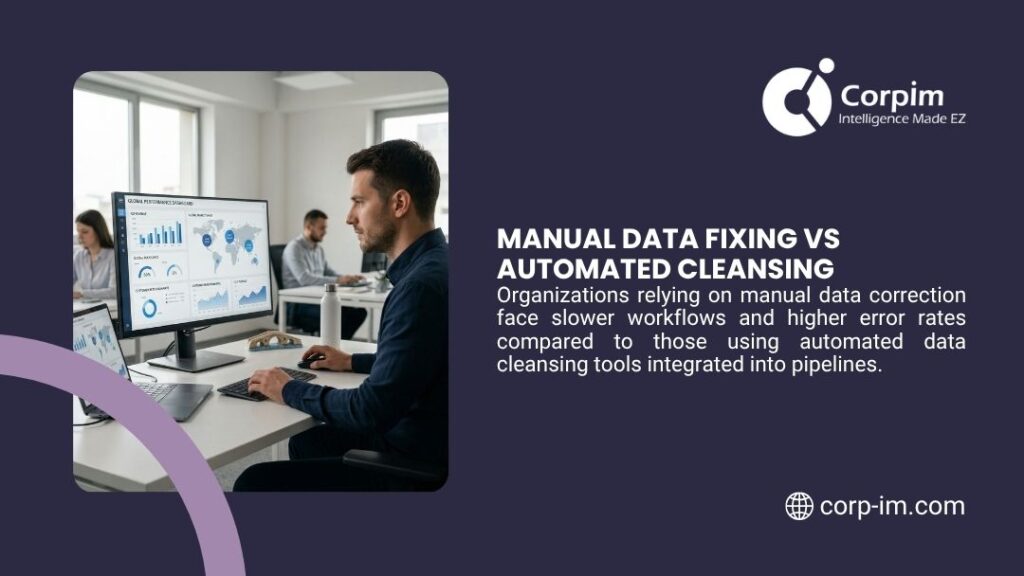
In enterprise discussions, the terms data cleansing and data cleaning often appear interchangeable. However, within structured IT environments, the distinction becomes clearer when viewed from a process and governance perspective.
Data cleaning usually refers to direct corrections within datasets, such as fixing errors, removing duplicates, or adjusting formats. It often takes place at a task level, handled by analysts or data teams working on specific datasets.
On the other hand, data cleansing reflects a broader and more systematic approach. It involves defined processes, governance rules, validation frameworks, and integration across systems. In many organizations, data cleansing forms part of a larger data quality strategy rather than a one-time activity.
| Aspect | Data Cleaning | Data Cleansing |
| Scope | Task-focused corrections | Organization-wide process |
| Approach | Manual or semi-automated fixes | Structured and governed framework |
| Frequency | Occasional or project-based | Continuous and integrated |
| Ownership | Analysts or individual teams | Enterprise data governance teams |
| Purpose | Fix immediate issues | Maintain long-term data quality |
Understanding this distinction helps organizations move beyond short-term fixes and adopt a consistent approach to data quality across their BI systems.
Data Cleansing Best Practices
Effective data cleansing does not depend on a single tool or method. It develops through consistent practices that align technology, processes, and governance. Organizations that achieve reliable data environments typically embed data quality standards into their broader analytics and IT strategies.
A strong starting point involves defining clear ownership of data across departments. When responsibility remains unclear, inconsistencies tend to persist across systems. Establishing governance frameworks allows teams to apply uniform rules for validation, formatting, and data usage.
Automation also plays a key role, particularly in large-scale environments. As data volumes grow, manual correction becomes inefficient. Automated validation and transformation processes help maintain accuracy without slowing down operations.
Integration across systems further supports data consistency. When datasets remain isolated, discrepancies increase. Unified data pipelines enable consistent data flow and reduce fragmentation across platforms.
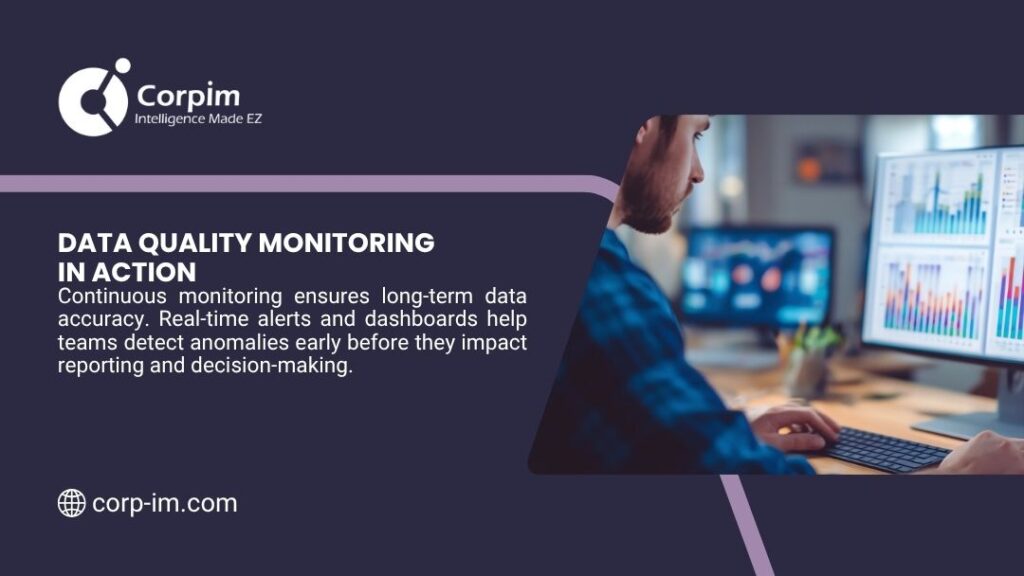
Finally, continuous monitoring ensures that data quality remains stable over time. Instead of treating data cleansing as a one-time activity, organizations that maintain high-quality BI systems adopt ongoing review processes to detect and resolve issues early.
These practices, when applied consistently, create a stable data foundation that supports accurate reporting, improved analytics, and long-term business performance.
Cost of Poor Data Quality
Data quality issues have measurable financial and operational impacts.
| Impact Area | Consequence |
| Revenue | Loss due to incorrect decisions |
| Operations | Inefficiencies and delays |
| Compliance | Increased regulatory risks |
| Customer Experience | Reduced trust and satisfaction |
Organizations often evaluate these risks through resources like the cost of bad data decisions.
Data Cleansing and ROI
The return on investment from clean data becomes visible across multiple business functions.
| Benefit | Outcome |
| Reporting Accuracy | Better decision-making |
| Efficiency | Reduced operational costs |
| Insights | Deeper analytics capabilities |
| Growth | Improved strategic planning |
Measurement frameworks, such as analytics ROI calculation, help quantify these benefits.
Role of Data Cleansing in Modern BI Architecture
Data cleansing supports the broader architecture of enterprise analytics systems. It connects data integration, transformation, and reporting into a unified process.
| Component | Role |
| Data Integration | Combines multiple data sources |
| API Connectivity | Enables system communication |
| Legacy Modernization | Updates outdated systems |
| AI Readiness | Prepares data for advanced analytics |
Data Cleansing for BI and Digital Transformation
Data cleansing plays a foundational role in digital transformation initiatives. As organizations transition toward cloud platforms and advanced analytics systems, clean data ensures consistency and scalability.
From enterprise experience, data modernization projects often face challenges when legacy systems contain inconsistent or incomplete datasets. Addressing these issues early supports smoother transitions and better long-term outcomes.
Organizations seeking structured transformation approaches often explore solutions through Corpim to align data, analytics, and business goals.
FAQs
What is data cleansing for BI?
Data cleansing for BI refers to the process of preparing clean, accurate datasets for business intelligence systems to ensure reliable insights.
Why is data cleansing important?
It improves data accuracy, supports better decisions, and enhances analytics performance.
What tools are used for data cleansing?
Common tools include ETL platforms, BI tools, and AI-based data cleaning solutions.
How often should data cleansing be performed?
It should be a continuous process integrated into data pipelines.
What is the difference between dirty data and clean data?
Dirty data contains errors and inconsistencies, while clean data is accurate, complete, and structured.
Final Takeaway
Data cleansing for BI supports reliable analytics, accurate reporting, and confident decision-making across enterprise environments. Organizations that treat data quality as a continuous discipline rather than a one-time effort build stronger foundations for analytics, cloud adoption, and long-term digital transformation.