Measuring BI success remains one of the most misunderstood challenges in enterprise IT. Many organizations deploy modern business intelligence platforms yet struggle to connect dashboards, reports, and analytics outputs to real business results.
This article explains how enterprise leaders can define, track, and validate BI value through the right metrics, governance practices, and cloud-enabled architecture. The goal focuses on clarity, accountability, and measurable business outcomes rather than vanity metrics or tool adoption alone.
Measuring BI Success Starts With Business Outcomes, Not Dashboards
Measuring BI success requires discipline, context, and executive alignment from day one. Too many BI programs launch with visual dashboards yet lack a framework that measures business impact. Within the first phase of any BI project, leadership must define what success means in operational, financial, and strategic terms.
In enterprise environments, business intelligence exists to support decisions that affect increased revenue, cost control, risk exposure, and customer experience. A dashboard alone does not measure success. Success appears when leadership trusts data, teams act on insights, and performance shifts in a measurable way.
Organizations that treat BI as a reporting layer often struggle to justify ongoing investment. Those that treat BI as a decision platform can clearly measure business success across departments, regions, and product lines. This difference drives long-term ROI and executive confidence.
To understand the foundation of modern business intelligence, many organizations start with a clear definition of business intelligence and its role within enterprise decision cycles.
Why Traditional BI Metrics Fail Enterprise Teams
Many enterprises still rely on surface-level measurements of success, such as dashboard count, report volume, or login frequency. These signals rarely reflect real value. Measuring success in business intelligence requires metrics that connect insight delivery to business behavior.
From a data architecture perspective, BI fails when data quality issues undermine trust, when delivery delays reduce relevance, or when metrics lack alignment with executive priorities. IT performance measurement must focus on how BI supports core business objectives rather than how often tools appear in use.
A BI program that lacks governance often produces conflicting KPIs across teams. This confusion weakens decision authority and slows response time. Strong BI strategies define ownership, metric standards, and escalation paths before dashboards reach executives.
Organizations that invest early in a clear business intelligence strategy often reduce rework and avoid costly redesigns later.
Core KPI Categories for Measuring BI Success
Enterprise BI success relies on multiple layers of measurement rather than a single score. Each layer answers a different executive question.
Business Impact KPIs
These indicators reflect whether BI contributes to measurable business outcomes. Examples include increased revenue tied to pricing insights, improved conversion rates after campaign analysis, or reduced operational costs from supply chain visibility. These KPIs matter most at the board and C-suite level.
A business intelligence KPI must directly support a business objective. If a metric fails to influence action, it does not belong in executive reporting.
Operational Performance BI KPIs
Operational KPIs evaluate how BI supports daily execution. Examples include forecast accuracy, cycle time reduction, or inventory turnover improvement. These measures business performance rather than tool usage.
Teams that align BI KPIs with operational scorecards see faster adoption and stronger trust across departments. Industry-specific KPI frameworks often appear in vertical-focused BI solutions such as automotive analytics.
IT and Data Platform KPIs
IT leaders track platform reliability, query response time, data freshness, and integration stability. These KPIs ensure BI tools deliver insights without friction. Data delivery speed and accuracy often determine whether users rely on BI or revert to spreadsheets.
For enterprises modernizing legacy systems, data systems modernization supports these goals through cloud-native pipelines and scalable architecture.
How to Measure BI Success Across the BI Lifecycle
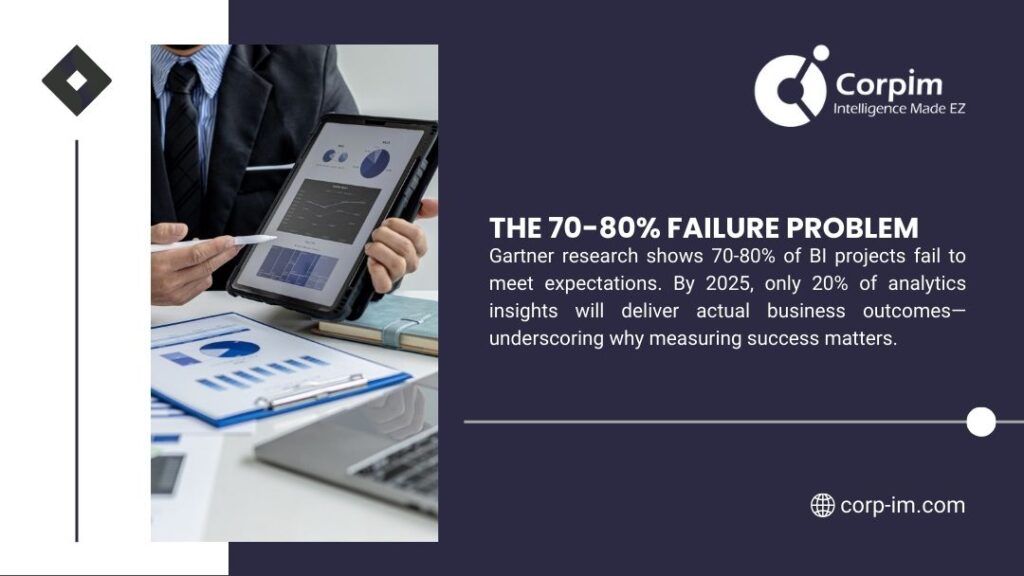
Measuring BI success changes as a BI program matures. Early phases focus on foundation and trust. Mature programs focus on optimization and scale.
Early-Stage BI Measurement
At launch, teams measure data accuracy, refresh reliability, and executive trust. If leadership questions numbers, BI adoption stalls. Data quality remains the first gate to success.
Early measurement also tracks user adoption patterns without overstating them. Adoption alone does not prove value, yet a complete absence of usage signals misalignment.
Growth-Stage BI Measurement
As BI expands, measurement shifts toward performance impact. Leaders ask whether BI insights reduce decision latency, improve forecasting accuracy, or enhance profitability.
In my experience working with enterprise cloud modernization projects, organizations that tie BI metrics to operational KPIs gain faster executive buy-in and budget stability.
Cloud computing models play a role here. Enterprises often compare public cloud computing, private cloud computing, and hybrid cloud computing based on scalability, cost, and compliance.
Mature BI Measurement
At scale, BI success measurement includes ROI analysis, total cost of ownership, and cross-domain consistency. Leaders evaluate whether BI supports enterprise performance management frameworks rather than isolated analytics. Enterprise performance management platforms align BI with planning, forecasting, and financial controls.
Measuring BI Success Through User Adoption Without Vanity Metrics
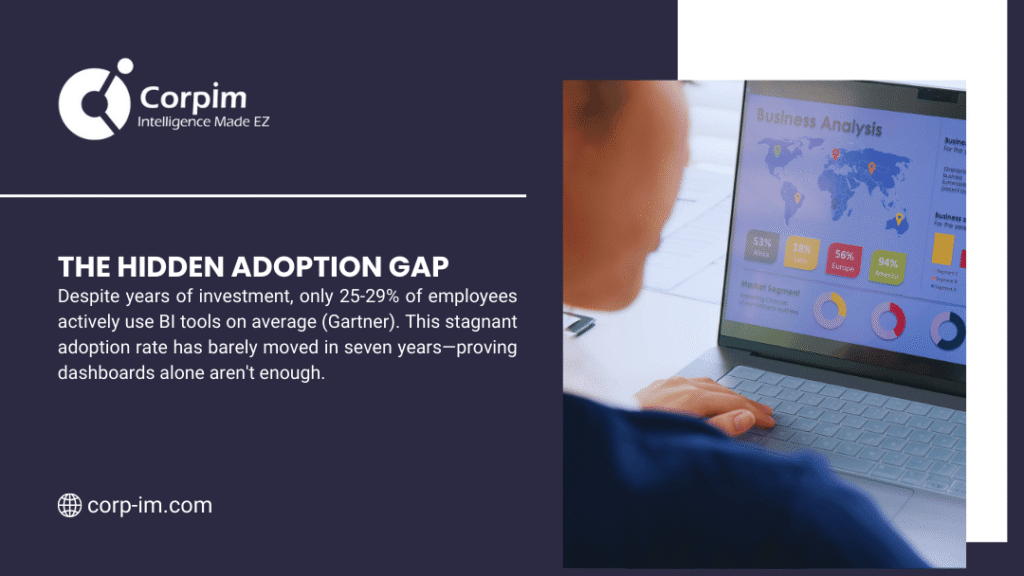
User adoption often appears as a misleading KPI. High login counts do not guarantee decision impact. Measuring BI success through adoption requires context.
Effective measurement looks at repeat usage for critical decisions, executive reliance during planning cycles, and reduction in manual reporting requests. When users trust BI, they stop asking for ad hoc extracts.
User adoption improves when BI solutions include role-specific dashboards, consistent definitions, and timely delivery. BI tools that overload users with metrics often reduce engagement rather than improve it. Organizations that pair adoption metrics with business outcomes avoid false confidence and identify real value drivers.
Data Quality as the Backbone of BI Success Measurement
No metric matters if data quality fails. BI success measurement must include completeness, accuracy, consistency, and timeliness indicators.
Poor data quality leads to costly decisions. Many enterprises now quantify the cost of bad data decisions as part of BI ROI analysis. This approach reframes BI investment as risk reduction rather than discretionary spend.
Data governance frameworks define ownership and accountability across data domains. Cloud-based architectures simplify enforcement through automated validation and lineage tracking.
Enterprises that invest in data pipeline architecture best practices often achieve more reliable BI outputs.
Industry Context Shapes BI KPIs and Success Criteria
BI success varies across industries. Financial services leaders prioritize risk metrics, regulatory accuracy, and forecasting stability. Healthcare teams focus on operational efficiency, patient outcomes, and compliance. Manufacturing organizations track throughput, quality variance, and supply chain resilience.
Industry-aligned BI solutions reflect these differences. Corpim supports sector-specific analytics across financial services, healthcare, insurance, and manufacturing. A generic KPI framework rarely fits every domain. Measuring BI success requires industry context and executive sponsorship.
BI Success Measurement in Cloud and Hybrid Architectures
Cloud adoption changes how enterprises measure BI success. Scalability, elasticity, and cost transparency become measurable advantages.
Hybrid cloud computing supports regulatory requirements while enabling advanced analytics workloads. Multi-cloud strategies reduce vendor dependency and improve resilience.
Cloud-based BI platforms enable faster experimentation and AI integration. Enterprises exploring AI for business intelligence often track model accuracy, decision uplift, and automation coverage as part of BI success measurement.
From BI KPIs to Executive Trust
Executive trust represents the ultimate measurement of BI success. When leadership uses BI during board reviews, budget planning, and strategic reviews, BI delivers value.
Trust emerges through consistent metrics, clear ownership, and alignment with enterprise goals. BI programs that lack governance struggle to earn this trust.
Professional services teams often bridge this gap by aligning architecture, data models, and reporting frameworks with executive priorities.
The Role of SaaS BI Platforms in Measuring Success
SaaS-based BI platforms simplify deployment, scaling, and governance. Solutions such as DataLynx Online support automated reporting, cross-location visibility, and operational consistency. SaaS platforms also improve measurement by standardizing KPIs across business units. This consistency enables leadership to compare performance without reconciliation delays.
Measuring BI Success With ROI and Cost Transparency
BI ROI measurement combines financial outcomes, efficiency gains, and risk reduction. Enterprises often track reduced reporting labor, faster decision cycles, and avoid compliance penalties.
Analytics ROI calculation must account for BI’s total cost of ownership, including infrastructure, licensing, integration, and support. Cloud-native BI platforms often reduce long-term cost through elasticity and automation.
Organizations that quantify BI ROI secure sustained executive sponsorship and continuous improvement funding.
Frequently Asked Questions
What defines measuring BI success at enterprise scale?
Measuring BI success at scale focuses on business impact, executive trust, and operational improvement rather than dashboard usage alone.
Which business intelligence KPIs matter most?
Business intelligence KPIs that link to revenue growth, cost reduction, risk mitigation, and decision speed deliver the strongest value.
How long does BI success measurement take?
Initial indicators appear within months, while mature ROI measurement often spans multiple planning cycles.
Does cloud adoption improve BI success measurement?
Cloud adoption improves scalability, transparency, and data delivery speed, which strengthens BI measurement accuracy.
Who owns BI success measurement?
Shared ownership across IT, data governance, and business leadership produces the strongest outcomes.

Closing Takeaway
Measuring BI success requires more than dashboards and adoption metrics. Enterprises that connect BI KPIs to business outcomes, data quality, and executive trust create analytics programs that endure.
With over 25 years of experience across cloud computing, data systems modernization, and enterprise performance management, Corpim supports organizations that seek measurable BI value rather than surface-level reporting.