BI adoption challenges remain one of the biggest barriers to enterprise success in data-driven environments. Many organizations invest heavily in business intelligence platforms yet struggle with low adoption rates, poor data quality, and a lack of alignment between IT and business teams.
This article explores the root causes of BI adoption challenges, outlines practical solutions, and highlights how a structured data strategy, supported by modern cloud and analytics frameworks, can unlock real business value.
Understanding BI Adoption Challenges in Modern Enterprises
BI adoption challenges affect organizations across industries, regardless of size or maturity. Despite strong investment in BI tools and data analytics, many companies fail to achieve consistent user adoption or actionable insights.
The problem rarely lies in the technology itself. Instead, gaps appear in strategy, data governance, user experience, and organizational alignment.
A strong foundation begins with a clear understanding of what business intelligence actually delivers: centralized data, real-time reporting, and a unified version of the truth. Yet without proper execution, these benefits remain out of reach.
From a data architecture perspective, the most common failure point is not the BI system but the ecosystem around it.
Top BI Adoption Challenges That Limit Enterprise Growth
Before diving into specific issues, it helps to understand that BI adoption rarely fails due to a single cause. In most enterprise environments, challenges build up over time, starting with small data inconsistencies and gradually expanding into system-wide trust issues. What looks like a tool problem is often a combination of data, process, and human behavior gaps.
1. Poor Data Quality and Lack of Governance
Poor data quality does more than create incorrect reports; it quietly erodes confidence across the organization. When executives receive conflicting numbers from different dashboards, the immediate reaction is not to question the data pipeline but to stop relying on the system altogether.
In many cases, data originates from multiple systems such as ERP, CRM, POS, and financial platforms, each with its own structure and rules. Without a clearly defined governance model, these systems produce overlapping or inconsistent datasets. Over time, this leads to multiple interpretations of the same metric, which directly impacts decision-making.
A deeper issue lies in the absence of ownership. When no team is responsible for maintaining data accuracy, problems remain unresolved. From experience in enterprise BI environments, governance only becomes effective when it is tied to accountability, not just policy documents.
Here is a simplified view of how governance gaps affect BI outcomes:
| Governance Area | Common Issue | Business Impact |
| Data ownership | No defined responsibility | Conflicting reports |
| Data standards | Inconsistent definitions | KPI misalignment |
| Data validation | Lack of checks | Poor data quality |
| Access control | Unrestricted usage | Data misuse |
Without addressing these layers, even the most advanced BI platforms struggle to deliver reliable insights.
2. Lack of a Clear Business Intelligence Strategy
A BI system without direction behaves like a reporting engine without purpose. Many organizations invest in dashboards and analytics tools before defining what success actually looks like.
A well-structured business intelligence strategy connects data initiatives to measurable outcomes. When that link is missing, BI becomes reactive rather than strategic. Teams build reports based on immediate requests instead of long-term goals, which results in fragmented analytics environments.
Another overlooked aspect is prioritization. Not every metric carries equal importance, yet without a strategic framework, organizations often track everything and understand very little. A structured strategy typically clarifies three essential elements:
| Strategic Element | Description |
| Business alignment | Connect BI outputs to revenue, cost, or performance goals |
| KPI definition | Establish consistent and measurable indicators |
| Data roadmap | Plan data integration and analytics evolution |
Without this clarity, BI adoption slows down because users fail to see how analytics supports their daily responsibilities.
3. Complex BI Tools and Poor User Experience
Many BI platforms are designed with technical flexibility in mind, but that flexibility often introduces complexity for end users. When dashboards require training just to interpret basic metrics, adoption naturally declines.
In real-world environments, business users prefer speed and clarity over advanced customization. If accessing insights feels like a technical task, they revert to spreadsheets or manual reporting methods.
Another factor is cognitive overload. Dashboards filled with excessive charts, filters, and metrics create confusion rather than clarity. Users need focused, role-specific views that highlight what matters most. A practical comparison illustrates this gap:
| Dashboard Type | User Experience | Adoption Outcome |
| Overloaded dashboards | Too many metrics, unclear focus | Low adoption |
| Simplified dashboards | Clear KPIs, minimal navigation | High adoption |
Organizations that prioritize usability during business intelligence implementation tend to achieve stronger engagement across departments.
4. Siloed Data Systems and Legacy Infrastructure
Legacy systems often store data in isolated environments, making integration difficult. As a result, organizations operate with disconnected datasets that fail to provide a unified business view.
These silos are not always obvious. In many enterprises, different departments rely on their own tools and reporting methods. Finance may use one system, operations another, and marketing a completely separate platform. When these systems do not communicate effectively, BI tools struggle to create a consistent narrative.
Over time, this fragmentation leads to delays in reporting and limits the ability to generate real-time insights. A simplified view of the problem:
| System Type | Integration Status | BI Impact |
| Legacy ERP | Limited connectivity | Delayed reporting |
| CRM platform | Partial integration | Incomplete customer view |
| External tools | No integration | Data gaps |
Transitioning toward modern architectures supported by cloud computing allows organizations to break down these silos and improve data flow across systems.
5. Low User Adoption and Cultural Resistance
Even when the technology works perfectly, adoption can still fail due to human factors. Employees often resist new systems when they feel those systems complicate their workflow or threaten established routines.
In many organizations, BI tools are introduced without proper onboarding or context. Users are expected to adopt new platforms without understanding how those tools improve their day-to-day responsibilities.
Another challenge is leadership involvement. When executives rely on intuition instead of data, it sends a signal that analytics is optional rather than essential. Cultural resistance often develops in stages:
| Stage | Behavior | Result |
| Initial rollout | Curious with hesitation | Limited engagement |
| Early usage | Inconsistent usage | Partial adoption |
| Long-term | Reversion to old habits | BI failure |
Sustained adoption requires continuous reinforcement, not a one-time implementation effort.
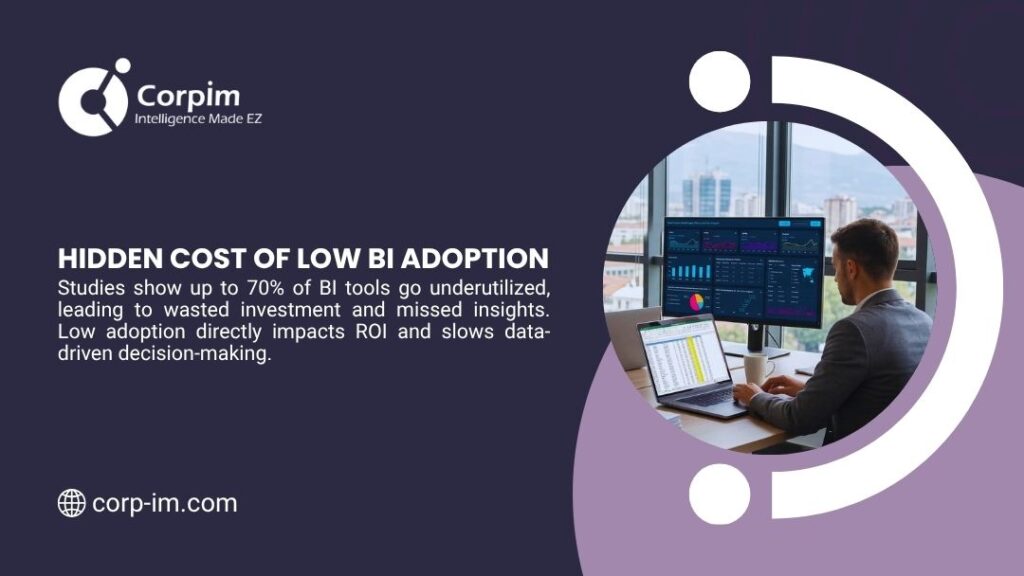
BI Adoption Challenges in Cloud and Data Modernization Context
Organizations that adopt cloud-based BI often experience faster scalability and improved analytics performance. However, challenges persist without proper architecture. A comparison of cloud models helps clarify this:
| Cloud Model | Strength | Limitation | Best Use Case |
| Public Cloud | High scalability | Shared infrastructure concerns | Rapid deployment |
| Private Cloud | High control | Higher cost | Sensitive data workloads |
| Hybrid Cloud | Flexibility | Complex integration | Enterprise environments |
Solutions such as private cloud computing, public cloud computing, and hybrid cloud computing play a key role in addressing BI adoption challenges.
How AI and Modern BI Platforms Address Adoption Challenges
AI has shifted how organizations interact with data, especially in environments where manual analysis slows decision-making. Instead of requiring users to interpret raw data, AI-powered systems highlight patterns, detect anomalies, and surface insights automatically.
With AI in business intelligence, users no longer need deep technical expertise to extract value from BI platforms. This reduces dependency on IT teams and increases accessibility across business functions.
Another important shift lies in predictive analytics. Traditional BI focused on historical reporting, while modern platforms extend into forecasting and scenario analysis. This makes BI more relevant to forward-looking decisions rather than just retrospective analysis.
The evolution can be summarized as follows:
| BI Capability | Traditional Approach | AI-Enhanced Approach |
| Reporting | Static dashboards | Dynamic insights |
| Analysis | Manual exploration | Automated pattern detection |
| Forecasting | Limited accuracy | Predictive modeling |
| User interaction | Technical interface | Natural, user-friendly |
When combined with big data analytics, AI-driven BI systems create a more intuitive experience, which directly improves adoption rates.
Solving BI Adoption Challenges: A Practical Framework
Addressing BI adoption challenges requires a structured approach rather than isolated fixes. Each improvement must connect to a broader data and analytics strategy to ensure long-term success.
1. Build a Strong Data Foundation
A reliable BI environment starts with clean, consistent, and well-structured data. Without this foundation, even advanced analytics tools fail to deliver meaningful results.
Data consistency depends on standardized definitions, validation processes, and centralized storage. Organizations that invest in data preparation early avoid costly corrections later.
A structured approach often includes:
| Data Layer | Purpose |
| Data cleansing for BI | Remove inconsistencies |
| Data modeling | Create standardized structures |
| Data governance | Maintain long-term quality |
A well-defined business intelligence data strategy ensures that data remains accurate and usable across the organization.
2. Align BI with Business Objectives
BI must reflect real business priorities. When analytics outputs fail to connect with measurable outcomes, adoption naturally declines.
Alignment requires collaboration between IT teams and business stakeholders. Metrics should reflect operational realities rather than abstract technical indicators. This alignment improves business intelligence ROI and supports better analytics ROI calculation.
Organizations that focus on measurable impact, such as revenue growth, operational efficiency, or cost reduction, see stronger engagement. Tracking performance through frameworks like measuring BI success helps maintain this alignment over time.
3. Simplify the User Experience
User experience plays a direct role in adoption rates. BI systems must provide clarity without overwhelming users. Effective dashboards present information in a structured and intuitive way. Role-based access ensures that each user sees only the data relevant to their responsibilities.
A simple structure improves usability:
| Design Element | Impact |
| Clear KPIs | Faster decision-making |
| Minimal navigation | Reduced friction |
| Role-based views | Higher relevance |
Simplification is not about reducing capability but about improving accessibility.

4. Invest in Cloud and Scalable Architecture
Scalability becomes essential as data volume grows. Cloud-based environments support flexibility and integration across systems. Organizations that adopt modern infrastructure benefit from faster processing, improved accessibility, and reduced operational constraints.
A comparison of scalability factors:
| Architecture Type | Scalability | Flexibility |
| On-premise | Limited | Low |
| Cloud-based | High | High |
Understanding cloud computing helps organizations choose the right architecture for long-term growth.
5. Encourage Data-Driven Culture
Technology alone cannot drive adoption. Organizational mindset plays an equally important role.
When employees see data as a core part of decision-making, adoption improves naturally. This requires consistent leadership support and clear communication of BI value.
Cultural transformation often develops through gradual reinforcement rather than sudden change.
Industry-Specific BI Adoption Challenges
Different industries experience BI adoption challenges in unique ways due to regulatory requirements, operational complexity, and data sensitivity.
| Industry | Key Challenge | BI Focus Area |
| Automotive | Multi-location data visibility | KPI tracking and performance metrics |
| Financial Services | Compliance and risk analysis | Secure analytics and forecasting |
| Healthcare | Data privacy and integration | Patient data management |
| Insurance | Fraud detection | Claims analytics |
| Manufacturing | Supply chain complexity | Operational efficiency |
Each industry benefits from tailored solutions such as business intelligence services for healthcare or business intelligence consulting for financial services.
Adoption improves significantly when BI systems align with industry-specific workflows rather than generic frameworks.
The Role of Enterprise BI Consulting
Enterprise BI consulting bridges the gap between technology and business outcomes. Organizations often require external expertise to design scalable architectures and integrate complex systems.
Through business intelligence consulting enterprise, companies gain access to structured methodologies that reduce risk and improve implementation success.
Consulting also introduces best practices in data governance, system integration, and analytics design. This ensures that BI systems evolve alongside business needs rather than becoming outdated.
A simplified view of consulting value:
| Consulting Area | Outcome |
| Architecture design | Scalable BI systems |
| Data integration | Unified data environment |
| Performance optimization | Faster insights |
For smaller firms, tailored support through business intelligence consulting SMB ensures scalable growth.
Why BI Adoption Challenges Persist Despite Investment
Even with significant investment, many organizations continue to struggle with BI adoption. The root cause often lies in unrealistic expectations. Companies assume that technology alone will solve underlying data and process issues.
Another factor is fragmented ownership. When multiple teams handle different parts of the BI ecosystem, accountability becomes unclear. This leads to delays in issue resolution and inconsistent system performance.
There is also a tendency to underestimate the complexity of data ecosystems. Integrating multiple systems requires careful planning, yet many projects rush into implementation without addressing foundational gaps.
Financial impact becomes visible when organizations calculate the cost of bad data decisions, which often reveals hidden inefficiencies.

Future Trends in BI Adoption
BI continues to evolve as organizations demand faster, more accurate insights. One noticeable trend is the shift toward real-time analytics, where decisions rely on live data rather than historical reports.
Another trend involves increased use of AI to automate analysis and reduce manual effort. As platforms become more intuitive, user adoption improves across non-technical roles.
Integration also plays a central role. Modern BI systems connect seamlessly with cloud platforms, APIs, and enterprise applications, creating a unified data environment.
Insights from business intelligence trends indicate that organizations focusing on integration and usability achieve higher long-term success.
FAQs
What are BI adoption challenges?
BI adoption challenges refer to barriers that prevent organizations from effectively using business intelligence systems, such as poor data quality, low user adoption, and a lack of strategy.
Why do BI implementations fail?
Failures often result from weak data governance, unclear objectives, and complex tools that users cannot easily adopt.
How can organizations improve BI adoption?
Focus on data quality, user experience, cloud infrastructure, and alignment with business goals.
What role does AI play in BI adoption?
AI enhances analytics by automating insights, improving accuracy, and simplifying data interpretation.
How does cloud computing impact BI adoption?
Cloud platforms improve scalability, integration, and real-time access, which supports higher adoption rates.
Is Power BI still in demand in 2026 and after 2026?
Yes, Power BI remains widely used due to its integration with Microsoft ecosystems and continuous updates.
What are the drawbacks of BI?
BI systems can become complex, expensive, and difficult to maintain without proper governance and strategy.
What are the 4 pillars of BI?
Data collection, data storage, data analysis, and data visualization.
What are the three pillars of BI governance?
Data quality, data security, and data management processes.
What are the 5 stages of business intelligence?
Data collection, integration, analysis, reporting, and decision-making.
Final Takeaway
BI adoption challenges do not stem from technology limitations but from gaps in strategy, data quality, and user engagement.
Organizations that invest in structured data governance, cloud-based infrastructure, and user-friendly BI systems achieve higher adoption rates and stronger business outcomes.
For enterprises seeking long-term success, the focus must shift from tool deployment to building a complete data ecosystem that supports consistent, actionable insights.