Business intelligence is supposed to bring clarity. Better data, better decisions, better outcomes. Yet in reality, many organizations invest heavily in BI tools and still feel like they are guessing. This article breaks down why BI projects fail, not from a theoretical angle, but from what actually happens inside companies. You’ll also see what separates systems that quietly fade away from those that genuinely support business growth.
Why BI Projects Fail More Often Than Teams Expect
There’s a gap that almost nobody talks about honestly during a BI rollout. It’s the gap between a system that technically works and a system that people actually use. These are very different things, and confusing them is where most projects start to go sideways.
You can have a beautifully architected data warehouse, a well-designed dashboard suite, and solid underlying data, and still end up with a BI environment that has almost no impact on how decisions get made. Because if the reports don’t speak to what managers actually need to know, or if the numbers shift every time someone pulls a different report, or if the platform feels clunky compared to just texting a colleague, people will take the path of least resistance.
Adoption isn’t a launch event. It’s earned, slowly, through reliability and relevance. The organizations that get this right tend to approach business intelligence differently from the start. They don’t just ask what data do we have? They ask, what decisions are we trying to make better? That single shift in framing changes everything downstream: the architecture, the report design, the training, the governance. All of it flows from purpose.
The Numbers Tell a Familiar Story
The statistics around BI failure rates vary depending on who’s publishing them, but the direction is consistent: a significant share of BI initiatives don’t deliver what was originally expected. Some estimates put the failure or underperformance rate above 70-80%. Others land lower. What matters more than the exact number is understanding how projects fail.
Most don’t fail spectacularly. They don’t get canceled or blow up in a public way. They just fade. The system runs in the background. Reports get generated. But nobody acts on them. Nobody trusts them enough to. And eventually the organization accepts this as normal, which might be the worst outcome of all, because it makes the next attempt harder.
The failure modes worth understanding fall into a handful of patterns that show up again and again, regardless of company size or industry.
Why BI Projects Fail: The Real Reasons Behind It
The following are the reasons why BI projects fail.
Data Quality Problems Start Early and Compound Fast
Ask any data professional about their biggest headache, and they’ll say some version of the same thing: the data was messier than anyone expected. This is so common it’s almost a cliché, but it still catches organizations off guard every time.
It usually starts with something small. A customer record appears in two systems with slightly different names. A date field gets formatted differently across regions. A sales figure is calculated one way in the CRM and a slightly different way in the ERP. None of these things seems like a crisis individually. But when you pull them into a single reporting environment, the cracks become visible fast.
Finance sees one number for quarterly revenue. Operations sees another. Nobody’s technically wrong; they’re just pulling from different sources using different rules. But the moment that happens, trust in the BI system takes a hit that it may never fully recover from.
This is why business intelligence consulting that’s worth anything starts with data quality, not dashboards. The visual layer is the last thing you should be worrying about. The first thing is making sure the underlying data is clean, consistent, and governed in a way that keeps it that way over time.
Data cleansing for BI environments isn’t glamorous work. But it’s foundational. Skipping it to get to the exciting part faster is one of the most reliable ways to guarantee a system people don’t trust six months from now.
Systems That Don’t Communicate Create Reporting Blind Spots
Most companies don’t run on a single system. They’ve accumulated tools over the years, a CRM from one vendor, an ERP from another, a cloud apps layered on top, plus a collection of internal tools built or bought to solve specific problems. Each of these holds a piece of the picture.
The challenge with BI is that you need those pieces to fit together. A report that shows sales performance without operational cost context, or customer behavior without support ticket data, is telling an incomplete story. And incomplete stories lead to incomplete decisions.
Without a well-designed data pipeline architecture, information stays siloed. Teams spend time reconciling numbers across systems rather than acting on insights. And the BI platform, rather than simplifying things, becomes one more system to maintain that adds to the noise.
Getting this right requires more than technical integration. It requires a clear understanding of how data should flow across the business, what transformations need to happen along the way, and how to ensure consistency when the same entity (a customer, a product, a transaction) appears in multiple systems under different IDs or formats. That kind of architecture work is where organizations with experienced solution architects earn their keep.
No Clear Business Direction from the Start
This failure mode is subtle and surprisingly common. A company decides it needs BI, and that decision is usually correct. But then the project gets handed off to the IT team, or to a vendor, and the conversation shifts almost immediately to technology. Which platform? What license tier? How many dashboards? What connectors do we need?
Somewhere in that conversation, the original business question gets lost. Nobody explicitly killed it. It just stopped being the center of gravity.
The result is a BI environment built around data availability rather than decision support. Reports get created because the data exists, not because anyone has a pressing need for the insight. The output is technically impressive and practically useless.
A real business intelligence strategy doesn’t start with the data. It starts with the decision. What does a regional sales director need to know every Monday morning to run her week effectively? What metric, if it moved by 10%, would require the operations team to act the same day? What question does the CFO ask every quarter that currently takes three analysts a week to answer?
When you build backwards from those questions, every design decision becomes easier. The dashboards mean something. The reports get used. And when someone asks why a number looks different from what was expected, there’s a clear owner who can answer.
People Avoid Platforms That Feel Like Work
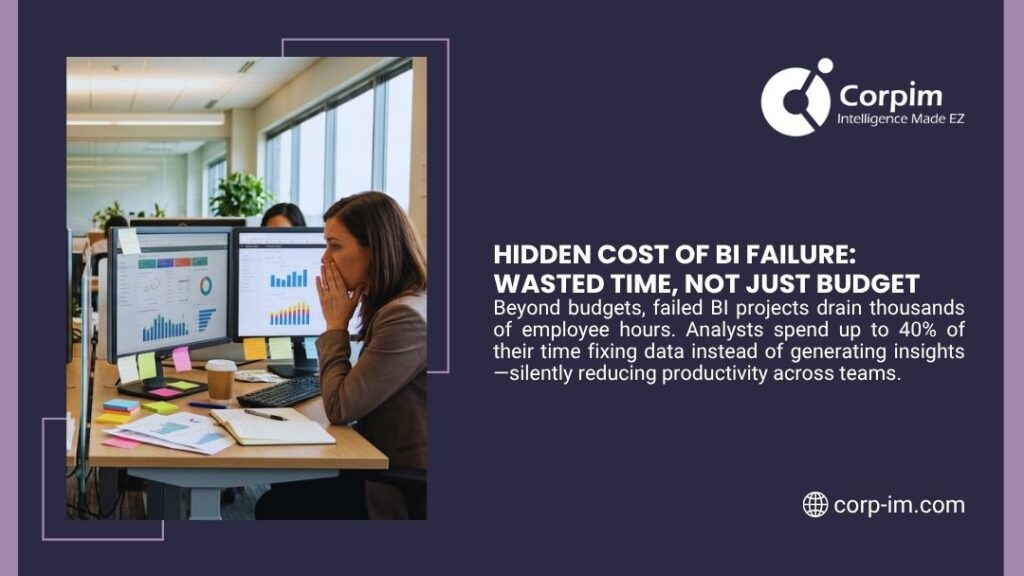
Technology adoption inside organizations is deeply shaped by friction. If using a tool feels harder than not using it, people won’t use it, even if the tool is genuinely useful. This isn’t laziness. It’s rational behavior.
BI platforms can be genuinely difficult. They can require users to understand data models, navigate complex filter hierarchies, or interpret visualizations that weren’t designed with their specific questions in mind. When that’s the experience, the spreadsheet waiting in the next tab starts looking very attractive.
Effective business intelligence reporting doesn’t show everything it could. It shows exactly what the relevant person needs, in a format they immediately understand, at the moment they need it. That’s a much harder design problem than building a technically comprehensive dashboard. It requires knowing your user, understanding their workflow, and being willing to make choices about what to leave out.
This is one of the things organizations with dedicated BI expertise do well, not just building reports, but designing intelligence delivery. The difference between a report that gets opened and one that drives action is usually not the data inside it. It’s the thoughtfulness of how it’s presented.
When Nobody Owns the Data, Everything Drifts
Here’s a scenario that plays out in a lot of organizations: a number in a report looks wrong. Someone notices. They flag it. A few people exchange emails. Nobody is quite sure whose responsibility it is to investigate. Eventually, it gets quietly dropped, and the next time that report is pulled, the same wrong number is still there.
This is a data governance problem, and it costs more than most organizations realize not just in the direct cost of bad decisions made on bad data, but in the slow erosion of confidence that makes people stop relying on the BI system at all.
Data governance sounds bureaucratic, but at its core, it’s just about accountability. Who owns each data set? Who is responsible for its accuracy? When something looks wrong, who has the authority and the knowledge to investigate and fix it? When definitions need to change because the business has changed, who makes that call and communicates it to everyone who depends on the data?
Without clear answers to those questions, data quality drifts. And a BI environment built on drifting data is one that people will eventually stop trusting, no matter how good the technology underneath it is.
Technology Complexity That Outgrows the Organization
Sometimes the barrier to successful BI isn’t a lack of technology, it’s too much of it, poorly integrated.
Different business units adopt different tools over time. One team loves a particular analytics product. Another team built something custom. The finance department has its own reporting environment that predates everything else. Over time, the organization ends up with a fragmented technology landscape that requires significant effort just to maintain, let alone improve.
This is where scalable cloud computing makes a real difference, not because cloud is inherently better, but because a well-designed cloud environment tends to force the architectural discipline that on-premise sprawl doesn’t. When you’re paying per resource used, there’s genuine incentive to consolidate, simplify, and build things that actually connect.
The goal isn’t the fanciest stack. It’s a coherent one. An environment where data flows reliably, where new tools can be integrated without breaking what’s already working, and where the people who depend on insights don’t have to understand the infrastructure to get value from it.
Why Larger BI Projects Struggle Even More
Scale introduces its own category of challenges. More stakeholders means more competing definitions of success. More data sources mean more integration complexity. More business units mean more places where data governance can break down quietly before anyone notices.
Large-scale BI initiatives also tend to suffer from a scope that expands faster than clarity does. The original objective gets buried under requirements from every team that’s been asked to contribute. Timelines slip. Decisions get deferred. And legacy systems, which were supposed to be temporary until the new platform was ready, keep running because nobody wanted to be the one to pull the plug.
The organizations that handle this well tend to break the problem into smaller pieces. Not because they lack ambition, but because smaller phases deliver faster value, which maintains the organizational support that large projects need to survive. A series of wins is more valuable than a comprehensive roadmap that produces nothing for eighteen months.
Cloud Changed the Economics of BI
For a long time, building a serious BI capability required serious infrastructure investment. Servers, storage, licensing, the upfront costs were significant enough that only larger organizations could build something genuinely capable.
Cloud shifted that. The cost model changed from capital expense to operational spend. The time from decision to deployment compressed from months to weeks. And perhaps most importantly, the ability to scale, to handle larger data volumes or more users without a hardware refresh cycle, became accessible to organizations that would have been priced out of that capability before.
Different configurations serve different needs. Public cloud computing offers flexibility and ease of management. Private environments offer control and security customization. Hybrid cloud computing has become a practical middle ground for organizations that need both regulated data kept in a controlled environment, with cloud-native tools handling analytics workloads on top.
What matters is alignment between the architecture and the actual needs of the business, not the prestige of a particular platform or vendor.
Legacy Systems Are Still Holding Many Organizations Back
There are organizations running analytics on infrastructure that wasn’t designed for it. Databases built in a different era, when data volumes were smaller, query patterns were simpler, and real-time anything was a distant concept. These systems work. They’ve worked for years. But they weren’t built for what businesses are asking of their data today.
The case for data systems modernization isn’t abstract. It’s practical. When your analytics environment can’t process data fast enough to support timely decisions, you’ve already accepted a structural disadvantage. When adding a new data source requires weeks of custom integration work, you’ve made speed a permanent cost. When your reporting environment can’t scale to handle peak demand, you’ve built a ceiling into your own capability.
Moving away from legacy infrastructure is genuinely hard. There are real risks, real migration challenges, and real organizational resistance to overcome. But the cost of staying isn’t zero, and it tends to grow over time.

The Same Challenges Across Every Industry: With Different Details
The root causes of BI failure are remarkably consistent across industries. The way they manifest is where the differences show up.
In the automotive sector, especially for operators managing multiple locations, visibility is often the first casualty. When each store runs its own reports in its own format, the people responsible for the whole organization are always working with incomplete information. Centralized platforms like DataLynx Online exist precisely to solve that: pulling fragmented data across locations into a single, consistent view that supports real operational decisions. Corpim’s DataLynx platform delivers over 200,000 reports and dashboards annually to automotive decision-makers across multi-store franchise groups.
Financial services organizations face a different pressure. Accuracy isn’t optional when regulatory reporting is involved. Inconsistent data doesn’t just mislead, it creates compliance exposure. That’s why business intelligence consulting for financial services has to treat data governance and auditability as first-class requirements, not afterthoughts.
In healthcare, the tension between data accessibility and privacy shapes everything. Getting intelligence to the people who need it, while maintaining the controls that patient privacy requires, demands an architecture built specifically for those constraints. Business intelligence services for healthcare can’t just import a model from another industry and expect it to work.
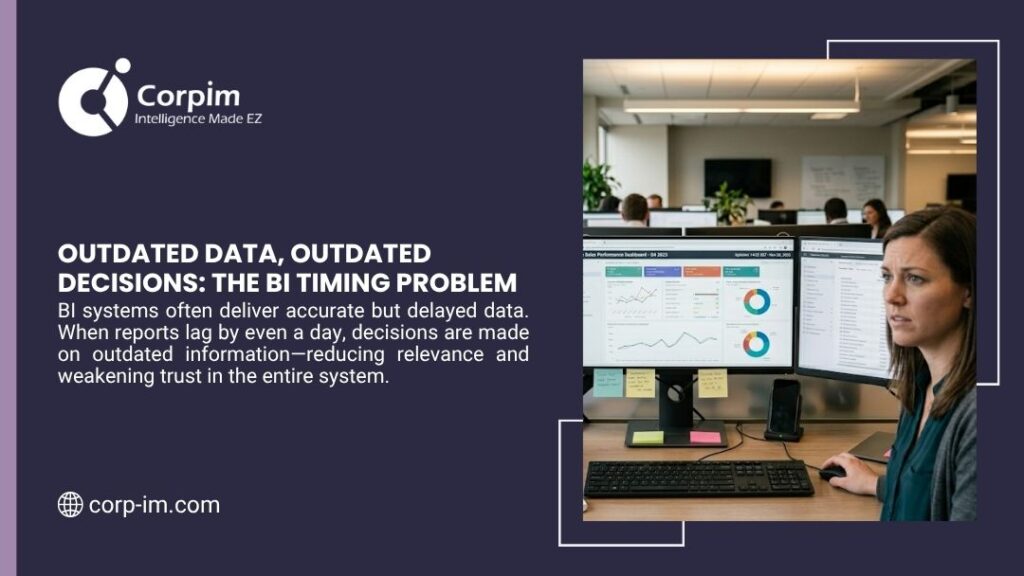
Manufacturing companies depend on operational data that’s timely and accurate. A production report that’s twenty-four hours old in an environment where throughput decisions are made every hour isn’t decision support, it’s history. Business intelligence consulting for manufacturing tends to focus on reducing that lag, which often means rethinking how data is collected and moved before worrying about how it’s visualized.
What Actually Reduces BI Failure Rates
There’s no single intervention that fixes a struggling BI program. But there are consistent patterns in what works.
Data quality gets attention before the dashboard layer. Not as an afterthought once reports start looking wrong, but as a foundational investment before anything gets built. Data cleansing for BI isn’t exciting, but it’s non-negotiable.
Architecture stays flexible. The business will change, and the BI environment needs to change with it. Building on platforms that can scale, whether that’s public cloud computing, private infrastructure, or a hybrid, means the system can grow without requiring a rebuild every few years.
Success gets measured. Analytics ROI calculation helps organizations understand whether the investment is actually delivering value, which in turn helps maintain organizational commitment and identify where to focus improvement efforts.
People get included early. Not just executives, but the analysts and managers who will actually use the system daily. Their feedback shapes what gets built, which dramatically increases the likelihood that what gets built gets used.
AI Is Reshaping What BI Can Do
Artificial intelligence is becoming a genuine part of how business intelligence platforms operate, not as marketing language, but as a functional capability that changes what’s possible.
The most useful applications right now aren’t the dramatic ones. There are things like anomaly detection that flag when a number falls outside its expected range before a human would have caught it. Pattern recognition that surfaces correlations in data that aren’t obvious from standard reporting. Predictive modeling that gives operations teams a forward-looking view rather than just a historical one.
AI in business intelligence adds real value when the underlying data is reliable. When it isn’t, AI doesn’t fix the problem; it amplifies it, generating confident-looking outputs from inconsistent inputs. This is another reason why data quality work comes first.
Organizations that are building AI capabilities into their BI programs thoughtfully, starting with the data foundation, adding AI where it genuinely adds insight rather than complexity, are the ones getting real results from it.
Where Corpim Fits Into This
Most organizations reach a point where internal effort alone isn’t enough to solve these problems. Not because the internal team lacks talent, but because BI transformation requires a specific combination of architectural experience, industry knowledge, and implementation depth that’s genuinely hard to build in-house.
Corpim has been working on exactly these problems across industries, including financial services, healthcare, insurance, manufacturing, and automotive. The approach is practical rather than theoretical: start with the business problem, build an architecture that actually supports it, and deliver intelligence in a format that people will use, not just a format that looks impressive in a demo.
Instead of treating BI as a separate function, it becomes part of how the business operates. Their expertise in enterprise performance management reflects that, aligning data with financial and operational goals.
FAQs About BI Projects
Why do BI projects fail even with the right tools?
Most failures come from gaps in strategy, data quality, and user adoption, not the tools themselves. Without trusted data and clear business alignment, even the best platforms fail to deliver real value.
What is the typical failure rate for BI projects?
Industry estimates place BI project failure between 50% and 80%. Many systems go live successfully but fail to influence real business decisions.
How does poor data quality lead to BI failure?
Inconsistent or conflicting data quickly breaks trust across teams. Once confidence is lost, users stop relying on BI and return to manual reporting.
What does effective data governance look like?
It requires clear ownership, defined metrics, and accountability for data accuracy. Strong governance ensures consistency, reliability, and long-term performance of BI systems.
How do organizations measure BI ROI?
ROI comes from improved efficiency and better decision outcomes. Tracking performance from the start helps guide future data and analytics investments.
What makes industry-specific BI more effective?
It delivers ready-built insights tailored to real operational needs. This reduces setup time and improves adoption across business users.
How is AI changing business intelligence?
AI helps uncover patterns and surface insights faster than traditional reporting. Its success depends on strong data foundations; poor data leads to unreliable outputs.
Final Thought
Understanding why BI projects fail is really understanding a pattern of decisions, decisions made early that have consequences that don’t show up until much later. Data quality work that gets deferred to save time. Business objectives that get replaced by technical ones. Users who get delivered a system rather than invited into one.
When data is reliable, systems are connected, and insights are easy to act on, BI becomes part of everyday decision-making. That’s what the investment was always supposed to buy. Not dashboards. Clarity.