BI tool consolidation has become a priority for organizations that rely heavily on analytics but struggle with too many disconnected systems. When multiple BI platforms coexist, data becomes harder to trust, reporting slows down, and teams spend more time fixing inconsistencies than actually using insights.
In practice, this shift doesn’t happen overnight; most organizations reach this point after years of gradual tool expansion.
This guide covers what that process actually involves, where it tends to go wrong, and what it looks like when it’s done right.
What BI Tool Consolidation Really Means in Practice
BI tool consolidation sounds straightforward: reduce the number of tools. In reality, it’s more about restoring clarity across the business intelligence ecosystem.
Most companies didn’t choose multiple BI tools on purpose. They accumulated them. One department picked a tool that fit their needs. Another team followed a different path. Over time, the organization ended up with overlapping dashboards, duplicate reports, and slightly different versions of the same metric. At that point, the issue isn’t just technical; it becomes operational.
Understanding Data Consolidation in Enterprise Systems
BI tool consolidation and data consolidation are related but distinct. Confusing them is one of the more common reasons consolidation efforts produce disappointing results.
Data consolidation is about the infrastructure layer. It refers to collecting, integrating, and storing data from multiple source systems into a unified repository, a data warehouse, a data lake, or a modern lakehouse architecture, so that downstream analytics systems all pull from the same governed source.
BI tool consolidation is about the analytics layer. It’s the process of reducing the number of platforms sitting on top of that infrastructure.
You can do one without the other. Organizations sometimes consolidate their BI tools onto a single platform while leaving the underlying data fragmented, which just means they’ve changed which interface people use to get contradictory numbers.
And organizations sometimes invest heavily in data infrastructure consolidation while leaving fifteen different reporting tools in place, which means the unified data layer never actually delivers unified insight.
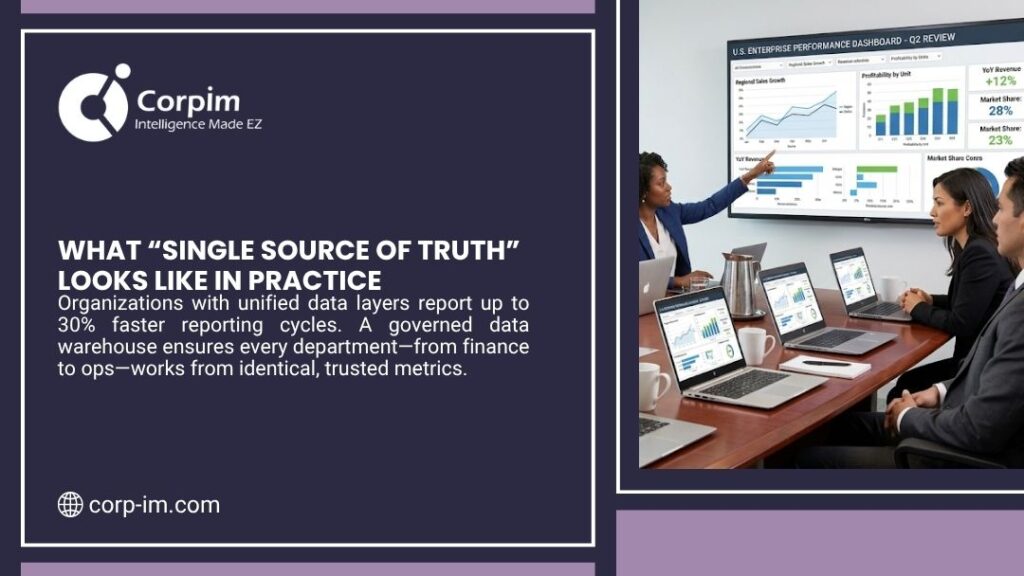
The pairing of the two is where the real value lies. A single, well-governed data foundation feeding a coherent analytics layer is what creates what practitioners sometimes call a single version of truth, a state where every report, regardless of who runs it or which department they’re in, reflects the same underlying reality.
| Area | BI Tool Consolidation | Data Consolidation |
| Focus | Reporting platforms | Data infrastructure |
| Goal | Reduce tool sprawl | Unify data sources |
| Primary outcome | Consistent dashboards | Reliable, governed datasets |
| Who leads | Analytics/IT | Data engineering/architecture |
| Typical timeline | 6–18 months | 12–24 months |
The two workstreams overlap in practice, and organizations that run them in parallel, with shared governance and a coordinated architecture vision, tend to reach the finish line faster than those that sequence them strictly.
The Real Drivers Behind BI Tool Consolidation
Understanding why organizations finally decide to consolidate, after years of tolerating fragmentation, helps clarify what the effort is actually about.
Tool sprawl has reached a tipping point. There’s usually a moment when fragmentation stops being an inconvenience and starts being a genuine operational problem. A leadership team that can’t get consistent numbers for a board presentation.
A compliance audit that surfaces data governance gaps. A data team that’s spending more time maintaining pipelines than building new capabilities. These moments drive consolidation decisions more reliably than abstract arguments about architectural purity.
The business needs faster insight. Modern organizations make decisions on shorter cycles than the legacy BI systems they inherited were designed to support. A consolidated architecture with a well-designed data layer can surface insights in hours rather than days. That speed difference isn’t a convenience; in competitive industries, it’s a structural advantage.
Cloud adoption created a forcing function. Moving to cloud infrastructure is a natural moment to rationalize the tools running on top of it. Organizations that are already migrating workloads to platforms like Azure, AWS, or Google Cloud often use that transition to consolidate their analytics environment at the same time, rather than lifting and shifting a fragmented mess into a new environment.
Total cost of ownership has become visible. As IT organizations have gotten better at measuring the real cost of their tool portfolios, including staff time, not just licensing, the case for consolidation has become easier to make to finance. When you can show that four BI platforms are costing more in maintenance and support than one good one would, the conversation changes.
Governance requirements have sharpened. Regulatory pressure in financial services, healthcare, and other industries has made data governance a board-level concern rather than an IT concern. Centralized systems are dramatically easier to audit, control, and demonstrate compliance with than fragmented ones.
Data Consolidation Techniques That Actually Work
Most enterprises don’t rely on a single method to consolidate data. Instead, they combine several approaches depending on system complexity and business requirements.
A centralized data warehouse remains one of the most common approaches. It acts as a structured environment where cleaned and standardized data is stored. This setup works well for reporting and analytics, especially when consistency is the priority.
Data lakes serve a different purpose. They allow organizations to store large volumes of raw data without a strict structure. This is useful for advanced analytics, machine learning, and scenarios where flexibility matters more than immediate usability.
API-based integration has become more important in recent years. Instead of relying on batch uploads, systems communicate directly, allowing data to move between platforms with minimal delay. This approach reduces latency and helps maintain accuracy across systems.
Another technique that often gets overlooked is master data alignment. Even with the right infrastructure, inconsistent naming conventions or definitions can create confusion. Aligning core entities such as customers, products, and locations ensures that all systems reference the same information.
In practice, successful consolidation usually combines these methods. The goal is not to force all data into one format, but to create a system where different data types can coexist while still producing consistent outputs.

BI Tool Consolidation in a Cloud Environment
Cloud platforms have changed the consolidation calculus in several important ways. The scalability that used to require significant capital investment in on-premise infrastructure is now available on demand. The time to deploy a new analytics environment has compressed from months to weeks. And the managed services available on major cloud platforms reduce the operational burden on data teams considerably.
The choice of cloud architecture depends on the organization’s specific constraints.
| Model | Description | Best For |
| Public cloud | Shared infrastructure, managed by the provider | Scalability, speed of deployment |
| Private cloud | Dedicated environment, higher control | Regulated industries, strict security requirements |
| Hybrid cloud | A mix of public and private, connected | Organizations balancing flexibility with compliance |
| Multi-cloud | Multiple public providers | Avoiding vendor lock-in, best-of-breed services |
Cloud environments simplify data storage consolidation and make it easier to support enterprise BI platforms without infrastructure constraints. Organizations that approach this with a clear modernization roadmap tend to move faster, especially when cloud architecture, data consolidation, and analytics strategy are aligned from the start.
Enterprise Performance Management and the Case for Consolidated Data
Enterprise Performance Management relies heavily on accurate and consistent data. Without consolidation, planning and forecasting become disconnected from reality.
EPM systems are designed to provide a unified view of performance across finance, operations, and strategy. However, when data sources remain fragmented, these systems inherit the same inconsistencies. Forecasts may look precise, but they are built on incomplete or conflicting inputs.
One common issue is misalignment between departments. Finance may base projections on historical financial data, while operations rely on real-time metrics. If these datasets are not reconciled, planning cycles become less reliable.
Consolidated data changes this dynamic. It allows organizations to build forecasts on a shared foundation, where all inputs follow the same definitions and structure. This improves accuracy and makes it easier to identify trends.
From experience, EPM systems tend to deliver the most value when they are supported by a well-structured data layer. Without that foundation, even the most advanced tools struggle to produce meaningful insights.
How BI Tool Consolidation Improves Business Outcomes
The business case for consolidation is strongest when it’s made in operational terms rather than technical ones. The improvements that matter to leadership aren’t architectural, they’re functional.
Decisions get made faster, with more confidence. When a regional manager can pull a performance report and trust what it shows, because it comes from the same system and the same definitions as every other report in the organization, they spend less time questioning the data and more time acting on it. That’s the compounding effect of a well-consolidated analytics environment.
Teams become more productive. The time data teams spend maintaining redundant pipelines, troubleshooting integration failures between siloed systems, and explaining why two reports show different numbers, that time gets redirected. Not to mention important work, but to genuinely higher-value analysis that a fragmented environment never had room for.
Costs come down, durably. License consolidation is the obvious win. But the more durable cost reduction comes from simplifying infrastructure, reducing the number of vendors to manage, and decreasing the support burden that comes with a fragmented environment. The savings compound over time as the organization stops paying the maintenance tax on tools it should have retired years ago.
Governance becomes enforceable. Consolidated systems make data access controls, audit trails, and retention policies manageable in a way that fragmented environments don’t. This matters for compliance, but it also matters for data quality, when accountability is clear and centralized, problems get caught and fixed faster.
Analytics ROI calculation tends to look most favorable in organizations that have consolidated their data environment. Not because consolidation is a magic multiplier, but because unified data enables the kind of reliable measurement that makes ROI visible in the first place.
Practical Steps to Implement BI Tool Consolidation
BI tool consolidation works best when approached as a structured transformation rather than a quick replacement project.
The first step involves creating a clear inventory of all existing tools. This includes identifying who uses each platform, what type of reports are generated, and how frequently those reports are accessed. Many organizations discover that some tools are rarely used, while others overlap significantly.
The next phase focuses on understanding business requirements. This goes beyond technical features and looks at how different teams rely on data. Finance, operations, and leadership often have distinct needs, and the future system must support all of them without unnecessary complexity.
Once requirements are defined, organizations can evaluate which platform or combination of platforms best fits their long-term goals. This decision should consider scalability, integration capabilities, and ease of use.
Data consolidation follows as a critical step. Before removing any tools, the underlying data must be aligned and validated. This ensures that reports remain accurate during the transition.
Migration typically happens in stages. Instead of switching everything at once, organizations move reports and users gradually. This reduces disruption and allows teams to adapt to the new system.
Finally, adoption becomes the focus. Training, support, and clear communication help ensure that users fully transition to the new environment. Without this step, even well-executed consolidation efforts can fall short.
Common Challenges in BI Tool Consolidation
BI tool consolidation often reveals challenges that were previously hidden within fragmented systems. While these obstacles are common, understanding them early makes it easier to manage the transition.
| Challenge | What It Means | Impact |
| Resistance to change | Teams prefer familiar tools | Slower adoption |
| Data quality issues | Inconsistent or incomplete data | Inaccurate reporting |
| Integration complexity | Legacy systems lack compatibility | Delays in implementation |
| Cost concerns | Upfront investment required | Budget hesitation |
| Skill gaps | Limited expertise in new tools | Dependency on IT teams |
These challenges are not unusual. Most organizations encounter at least a few of them during consolidation efforts. The key is to address them proactively rather than reactively.
Industry Use Cases for BI and Data Consolidation
Different industries experience BI tool consolidation in unique ways, depending on their operational complexity and data requirements.
In the automotive sector, organizations often manage multiple locations with separate systems. Consolidation allows them to bring together data from dealerships, service centers, and inventory systems into a unified view. This improves visibility into performance and supports better decision-making at both local and corporate levels.
Financial services organizations deal with large volumes of sensitive data. Consolidation helps create a consistent reporting framework, which is essential for compliance, risk management, and audit processes. Without it, discrepancies can lead to serious operational and regulatory issues.
Healthcare organizations rely on accurate and timely data to support patient care and operational efficiency. Consolidated data allows them to track performance metrics, manage resources, and improve service delivery.
In manufacturing, data often comes from production systems, supply chains, and logistics platforms. Consolidation provides a clearer view of operations, helping organizations identify inefficiencies and optimize processes.
The Role of SaaS Platforms in Simplifying Consolidation
SaaS platforms have changed how organizations approach consolidation by reducing the complexity of infrastructure and integration.
Instead of building custom systems from scratch, companies can use SaaS solutions that already include pre-configured integrations and reporting frameworks. This shortens implementation timelines and reduces the need for extensive development work.
Another advantage is scalability. SaaS platforms adjust to changing data volumes and user demands without requiring additional hardware or major system upgrades.
Automation also plays a key role. Many SaaS platforms include built-in features for data processing, reporting, and workflow management. This reduces manual effort and improves consistency across operations.
For organizations with distributed operations, SaaS platforms provide a centralized environment where all data can be accessed and analyzed. This is particularly useful for multi-location businesses that need real-time visibility across different sites.
BI Tool Consolidation vs. Data Warehouse Consolidation
These terms sometimes get used interchangeably in a way that creates confusion about what a consolidation project is actually supposed to accomplish.
| Factor | BI Tool Consolidation | Data Warehouse Consolidation |
| Layer | Analytics and reporting | Data storage and modeling |
| Primary focus | Dashboards, reports, self-service analytics | Data infrastructure, pipelines, schemas |
| Who it affects directly | Business users and analysts | Data engineers and architects |
| Outcome | Unified analytics experience | Centralized, governed data |
| Typical investment | Moderate, platform migration, training | High data migration, modeling, governance |
Data warehouse consolidation is often the more complex undertaking. It requires decisions about data modeling, historical data migration, and the reconciliation of business logic that may have developed differently across systems over the years.
It also creates the foundation that makes BI tool consolidation meaningful, because a unified analytics platform sitting on top of a fragmented data infrastructure is a cosmetic fix, not a structural one.
Organizations that have done both, consolidated the data layer and the analytics layer, in a coordinated way, report qualitatively different results from those that did one without the other. The combination is what produces the consistent, trusted analytics environment that justifies the investment.

FAQs About BI Tool Consolidation
What are the 4 pillars of BI?
The four pillars typically include data collection, data integration, data analysis, and data visualization.
What is an example of a BI tool?
Examples include Power BI, Tableau, and Qlik, which help organizations create dashboards and analyze data.
What are the two ways to consolidate data?
Data can be consolidated through centralized data warehouses or through real-time integration using APIs.
What are the 5 stages of business intelligence?
The stages include data collection, data storage, data processing, data analysis, and reporting.
Why is data consolidation important?
It ensures consistency, improves data accuracy, and supports better decision-making.
What is tool sprawl in BI?
Tool sprawl refers to the use of multiple BI tools across an organization, leading to duplication and inefficiency.
How does cloud computing support BI consolidation?
Cloud platforms provide centralized storage and scalable infrastructure, making consolidation easier.
Final Takeaway
BI tool consolidation is less about removing tools and more about restoring clarity. When data is aligned and reporting sits on a unified foundation, organizations move faster and make decisions with greater confidence.
This is particularly true in enterprise environments where data complexity spans multiple systems, industries, and operational layers, areas where structured modernization experience and architecture-led strategies tend to produce more consistent outcomes.
For companies working through this transition, having the right expertise makes a noticeable difference. A structured approach helps bridge the gap between fragmented systems and a modern, data-driven enterprise environment.
If your organization is dealing with fragmented BI tools or inconsistent data, the next step is not another tool, it’s a clearer architecture. Explore how a structured, data-first approach can simplify your analytics environment and support long-term growth at Corpim.