Scaling analytics infrastructure helps enterprises process larger data volumes, improve real-time insight, reduce report delays, and support AI-ready data architecture. A strong data infrastructure strategy connects cloud systems, data governance, analytics automation, and business intelligence, enabling leaders to make faster decisions with greater trust. For firms with complex legacy systems, the path to scalable analytics starts with a clear view of current data assets, modern cloud models, security and governance needs, and long-term enterprise performance goals.
What Is Scaling Analytics Infrastructure?
Scaling analytics infrastructure is the process of expanding and modernizing the systems, tools, cloud platforms, data pipelines, and governance controls that support enterprise analytics. It helps companies move from slow, siloed, manual data processes to flexible, secure, and scalable analytics environments.
At a basic level, data infrastructure refers to the full technical foundation that collects, stores, moves, protects, and delivers data. So, when leaders ask, what is data infrastructure? The answer includes databases, data warehouses, data lakes, APIs, data pipelines, cloud platforms, access controls, and analytics tools.
From a data architecture perspective, the goal is simple: create an infrastructure that supports current needs while also growing with business data volumes, AI training, compliance requirements, and future analytics demand.
A weak setup may work for one department. It may fail when finance, sales, IT, and operations all depend on the same data. That is why scaling analytics infrastructure has become a core priority for enterprise leaders.
For a broader foundation, Corpim’s guide to business intelligence explains how modern BI connects data, reports, and decisions across business units.
Why Scaling Analytics Infrastructure Matters for Enterprise Growth
Data has become central to strategy, cost control, customer insight, risk review, and operational performance. Yet many firms still rely on old database infrastructure, manual exports, spreadsheet chains, and disconnected SaaS tools.
That creates several issues:
- Reports take too long.
- Data teams repeat manual work.
- Executives lack one trusted source of truth.
- Security and governance risks rise.
- AI/ML projects lack clean, usable data.
- Data centers and cloud costs become hard to control.
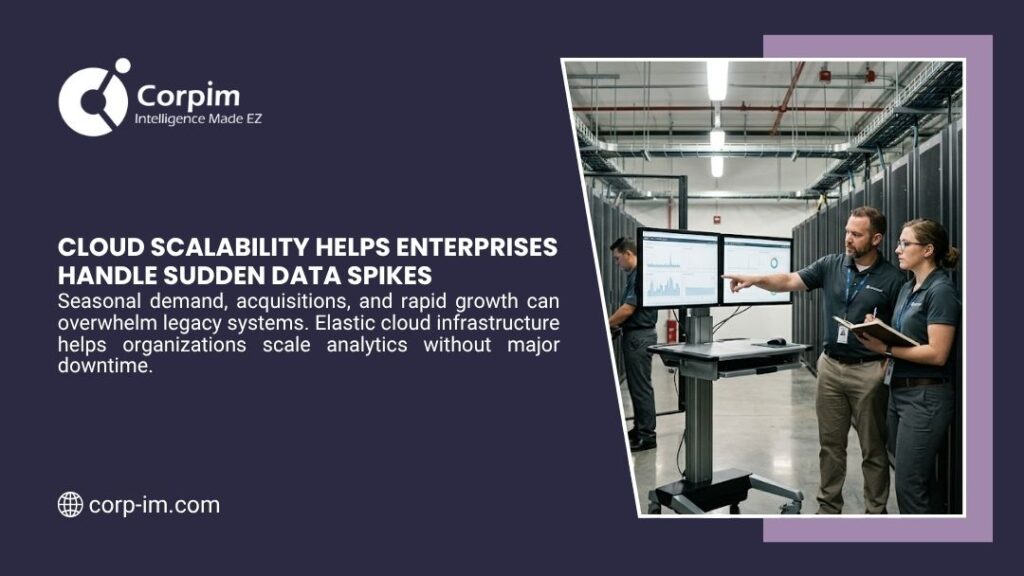
Scaling analytics infrastructure solves these issues by giving teams a more stable and elastic foundation. It enables organizations to process more data, serve more users, and add more analytics use cases without a full system rebuild each time demand rises.
In my experience with enterprise cloud modernization projects, the best results come when companies treat analytics infrastructure as a business system, not only an IT asset. The infrastructure supports finance forecasts, customer analytics, supply chain insight, compliance reports, and executive dashboards.
Microsoft’s Azure Well-Architected Framework reinforces this point by defining cloud architecture around “reliability, cost optimization, operational excellence, performance efficiency, and security.” This supports the need for an analytics infrastructure that can scale without losing control, resilience, or cost discipline.
Corpim’s focus on cloud computing fits this need because modern analytics depends on flexible cloud capacity, secure architecture, and clear cost control.
The Data Infrastructure Definition Enterprises Should Use
A practical data infrastructure definition is this: Data infrastructure is the combined set of platforms, databases, cloud services, pipelines, rules, and access controls that allow an organization to collect, store, process, govern, and use data.
That means data infrastructure and analytics are deeply connected. Analytics can only deliver value when the infrastructure below it is reliable. Common data infrastructure examples include:
| Component | Enterprise Role |
| Databases | Store structured business records |
| Data warehouses | Centralize clean data for reports |
| Data lakes | Hold large data volumes in varied formats |
| Data pipelines | Move and transform data across systems |
| APIs | Connect applications and data sources |
| Cloud platforms | Add compute, storage, and scale |
| Governance tools | Protect data quality and control over data |
| BI platforms | Deliver reports, dashboards, and analytics |
When leaders explore what data analytics is, they often focus on dashboards or models first. Yet the true value starts below the dashboard, inside the data analytics infrastructure.
Scaling Analytics Infrastructure Starts With a Data Infrastructure Strategy
A strong data infrastructure strategy defines how data should move, who can use it, where it should live, how it is protected, and how analytics tools should connect to it. Without that strategy, teams often add tools one by one. Over time, the result is tool sprawl, duplicate reports, high cost, poor data quality, and low trust.
A practical strategy for scaling analytics infrastructure should cover:
- Current data systems and gaps.
- Critical data sources.
- Cloud or hybrid cloud target state.
- Data governance rules.
- Security and access controls.
- Reporting and analytics priorities.
- AI/ML readiness.
- Cost, performance, and compliance goals.
This is where business intelligence strategy becomes useful. A BI strategy helps leaders connect data architecture to real business goals instead of tool selection alone.
Legacy System Modernization and the Role of Cloud
Many enterprises still have data spread across old ERP systems, on-premise databases, local files, and custom applications. These assets may still serve important business roles, but they often limit big data scalability.
Modernization does not always require a full replacement. It often starts with clear data integration, API connectivity, and cloud migration paths. A strong modernization plan may include:
- Move key data from old systems into a secure cloud data platform.
- Use APIs to connect SaaS tools and enterprise systems.
- Add a data lake or warehouse for analytics.
- Use data cleansing for quality control.
- Apply governance and access controls from the start.
- Create dashboards through BI tools.
Corpim’s data systems modernization service aligns with this exact challenge: shift from siloed, legacy systems to more connected, cloud-ready data platforms.
Cloud Models for Scalable Analytics Infrastructure
Cloud architecture plays a major role in analytics scale. The right model depends on data sensitivity, cost goals, workload type, control needs, and compliance requirements.
| Cloud Model | Best Fit | Analytics Benefit |
| Public cloud | Flexible workloads, fast scale, lower hardware burden | Rapid compute and storage access |
| Private cloud | Sensitive data, strict control is needed | More control over data and security |
| Hybrid cloud | Mix of on-premise and cloud systems | Gradual cloud migration with reduced disruption |
| Multi-cloud | Firms that use several cloud vendors | Vendor flexibility and workload choice |
A company may use public cloud computing for rapid analytics workloads, private cloud computing for sensitive data, and hybrid cloud computing for a phased migration.
From a practical view, most enterprise analytics programs use hybrid or multi-cloud designs because few firms can move all data at once. The right infrastructure supports staged modernization without business disruption.
AWS describes a data lake as a cloud foundation that can help organizations “analyze all their data” through varied analytics methods, including machine learning. This makes data lakes useful for enterprises that need scalable analytics, broader data access, and AI/ML-ready infrastructure.
Scaling Analytics Infrastructure With Data Governance and Security
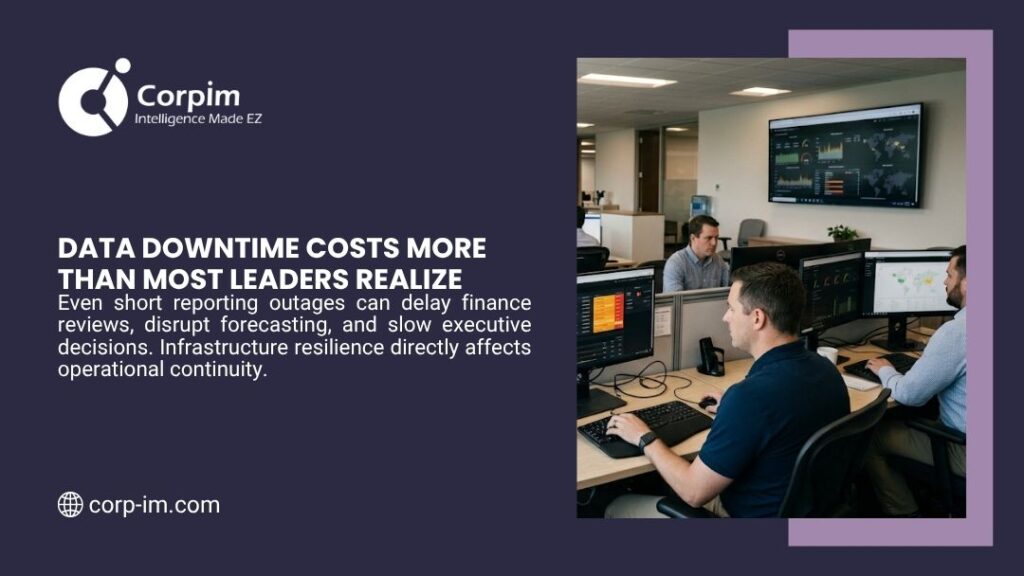
Security and governance must be part of analytics modernization from the first phase. As data volumes rise, the risk of poor access control, duplicate data, and compliance gaps also rises.
Strong data governance includes clear data ownership, role-based access controls, data quality rules, audit trails, data retention rules, master data definitions, compliance review, and secure data movement.
This protects control over data while it still enables organizations to use data across departments. For example, healthcare analytics may need strict privacy rules. Financial services may need audit-ready reporting. Manufacturing may need plant-level operational data, supply chain data, and finance data in one view.
Corpim’s work across healthcare, financial services, insurance, and manufacturing gives this topic strong industry relevance.
Data Pipelines: The Engine Behind Analytics Infrastructure
No analytics infrastructure can scale without sound data pipelines. A data pipeline moves data from source systems into a storage or analytics layer. It may clean, transform, combine, or validate data along the way.
For enterprise use, data pipeline architecture must support:
- Batch and real-time data.
- Error checks.
- Data lineage.
- API and database sources.
- Cloud storage targets.
- Security controls.
- Observability.
- Reusable data models.
For more detailed execution, data pipeline architecture best practices provide a natural next step. Poor pipeline design is one reason why BI programs fail. Data may arrive late, appear in the wrong format, or conflict with other reports. A scalable analytics infrastructure must reduce those risks before users lose trust.
Business Intelligence and Enterprise Analytics Optimization
Business intelligence turns raw data into useful reports, dashboards, and decision support. Yet BI depends on the strength of the infrastructure below it. When a scalable analytics infrastructure is in place, firms should review how BI tools connect to source data, how reports are built, who owns KPIs, and how users adopt dashboards.
Key BI priorities include:
- Trusted data models.
- Report automation.
- Self-service analytics.
- KPI governance.
- Executive dashboards.
- Mobile access.
- Performance alerts.
- Clear ownership of metrics.
Corpim’s information on business intelligence reporting, business intelligence benefits, and business intelligence implementation fits this middle layer between raw infrastructure and business value.
A strong BI setup gives users access to the right data at the right time. It also reduces the cost of bad data decisions, report duplication, and manual work.
Enterprise Performance Management and Analytics Scale
Enterprise Performance Management, or EPM, connects finance, operations, planning, reports, and forecasts. It gives leaders a more structured way to track results and future targets.
EPM becomes more powerful when connected to a scalable analytics infrastructure. It can draw from finance systems, ERP data, sales data, operations data, and external market data.
This supports:
- Budget plans.
- Forecasts.
- Variance analysis.
- Financial close reports.
- Operational KPIs.
- Scenario models.
- Executive scorecards.
Oracle states that Cloud EPM helps organizations “model and plan across finance, HR, supply chain, and sales,” which shows why enterprise performance management depends on a connected, trusted analytics infrastructure.
Corpim’s enterprise performance management capabilities are relevant for companies that need to move beyond spreadsheets and manual report cycles. A reliable analytics infrastructure supports faster EPM cycles because data flows from trusted systems into structured reports and dashboards.
Scalable Analytics for AI and Machine Learning
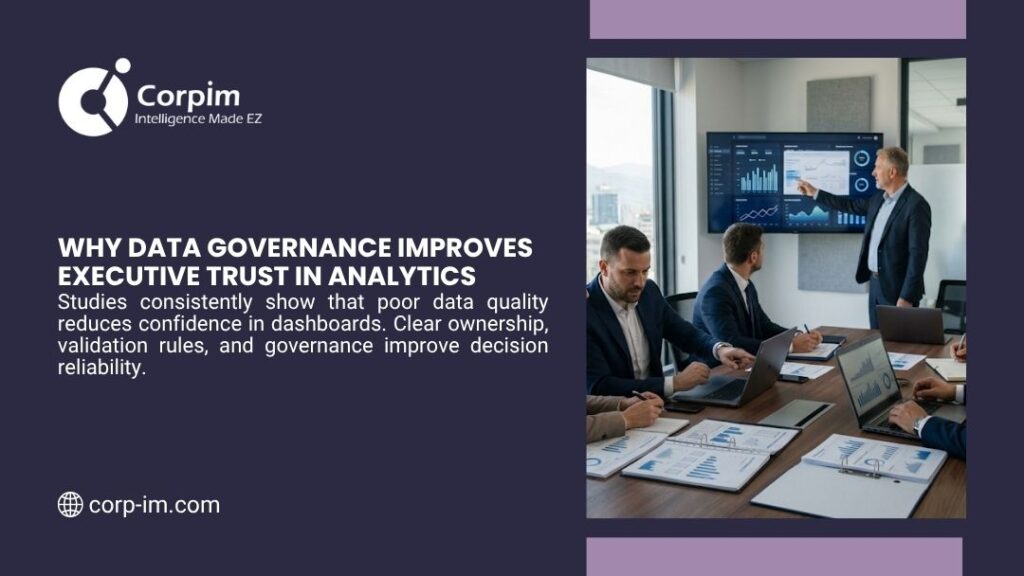
AI and machine learning require clean, connected, and well-governed data. Without a sound data science infrastructure, AI projects often remain stuck in pilot mode. AI training depends on high-quality data. Teams need data volume, data context, model-ready data sets, privacy controls, and compute capacity.
That is why data analytics infrastructure should be prepared for AI/ML readiness from the start, even if the first use cases are basic reports. Future-ready infrastructure may include:
- Data lakes for broad storage.
- Feature stores for model inputs.
- Data catalogs.
- Cloud computing for AI workloads.
- Governance rules for sensitive data.
- Model monitoring.
- Real-time data streams.
Resources on AI in business intelligence, AI for business intelligence, and AI tools for business can help readers connect analytics modernization with AI adoption.
Industry Use Case: Automotive Analytics and DataLynx
The automotive sector shows why scalable data analytics infrastructure matters. Multi-location service, tire, and dealership groups often rely on many systems for point-of-sale data, payroll, inventory, parts, finance, and customer reviews. When these systems remain disconnected, leaders lack a real-time view of performance.
Corpim’s DataLynx Online platform helps automotive businesses automate reports, parts reconciliation, payroll calculations, and performance dashboards. This is a real-world example of infrastructure analytics applied to a specific vertical.
For automotive leaders, what is KPI in the automotive industry is another strong internal content path because KPIs depend on reliable data flows.
The automotive sector also shows how analytics scale of analytics is not just about cloud storage. It is about daily operational clarity across stores, managers, accounting teams, and executives.
Cost Efficiency and Analytics ROI
A scalable analytics infrastructure should reduce long-term cost, not add more complexity. Yet cost control requires clear design choices. Common cost risks include:
- Overbuilt cloud environments.
- Too many BI tools.
- Duplicate data storage.
- Manual report labor.
- Poor data quality.
- Low user adoption.
- No clear ownership.
- Weak vendor control.
Enterprises should measure cost against business outcomes, including faster reports, reduced manual work, fewer errors, better forecasts, and improved decision speed. This includes analytics ROI calculation, business intelligence ROI, BI total cost of ownership, and cost of bad data decisions.
A mature program reviews both technical cost and business value. Cloud bills matter, but so do hours saved, decisions improved, and risk reduced.
Common Barriers to Scaling Analytics Infrastructure
Many firms know they need analytics modernization, yet progress stalls. The main barriers are often organizational, not technical.
| Barrier | Impact | Fix |
| Siloed data | Teams see different versions of the truth | Create shared data models |
| Legacy databases | Slow reports and limited scale | Modernize through cloud and APIs |
| Poor governance | Data trust declines | Define ownership and access rules |
| Tool sprawl | Cost and confusion rise | Consolidate BI and analytics tools |
| Weak adoption | Dashboards go unused | Train users and align KPIs |
| Bad data quality | Reports lose credibility | Add data cleansing and validation |
Corpim covers BI adoption challenges, data cleansing for BI, why BI projects fail, and BI tool consolidation to support those facing these issues.
A Practical Roadmap for Scaling Analytics Infrastructure
Enterprises can use this roadmap to plan analytics infrastructure growth.
1. Audit current data assets: Start with databases, reports, cloud tools, data centers, APIs, file stores, and BI platforms. Find duplicate systems, weak points, and high-risk data flows.
2. Define business goals: Analytics should support business needs such as revenue growth, cost control, compliance, customer insight, or operational efficiency.
3. Build a target architecture: Choose the right mix of cloud, data warehouse, data lake, pipelines, BI tools, and governance controls.
4. Prioritize data quality: No analytics strategy works without trusted data. Add cleansing, validation, lineage, and ownership rules early.
5. Modernize in phases: Avoid a high-risk “big bang” program. Move high-value data domains first, then expand.
6. Add governance and security: Use role-based access controls, audit logs, encryption, and clear policy rules.
7. Measure adoption and ROI: Track user adoption, report speed, error reduction, cloud cost, and business outcomes.
This type of roadmap often requires expert support. Corpim’s professional services and business intelligence consulting services fit companies that need architecture guidance, vCIO support, or custom analytics design.
How Corpim Fits the Enterprise Data Modernization Journey
Corpim, also known as Corporate InfoManagement, is a U.S.-based digital transformation and DataTech company with deep experience in cloud, data systems modernization, EPM, BI, and industry-specific SaaS.
The company presents its long history in business consulting, IT services, DataLynx, centers of excellence, cloud EPM, and modern data systems. That history supports a practical message: enterprise analytics works best when business process knowledge and technical architecture work together.
Corpim’s service mix is relevant for companies that need:
- Cloud migration strategy.
- Analytics infrastructure design.
- Enterprise performance management.
- Data governance and reporting.
- Custom BI solutions.
- Automotive SaaS support.
- IT leadership and architecture help.
For enterprise readers, Corpim can be framed as a trusted partner for analytics modernization because its services cover the full chain: cloud platforms, data modernization, BI, EPM, and professional IT guidance.
FAQs
1. What is data infrastructure and analytics?
Data infrastructure and analytics refer to the systems, tools, pipelines, and governance rules that allow a company to collect, process, protect, and analyze data. The infrastructure supports analytics by making data accessible, accurate, and secure.
2. Why is scaling analytics infrastructure important?
It is important because enterprise data volumes continue to rise. Without scalable systems, reports slow down, costs rise, data quality drops, and AI or real-time analytics projects become harder to support.
3. What are common data infrastructure technologies?
Common data infrastructure technologies include cloud platforms, databases, data warehouses, data lakes, APIs, ETL tools, BI platforms, data catalogs, access controls, and governance systems.
4. How does cloud computing help analytics infrastructure?
Cloud computing helps analytics infrastructure by adding flexible storage, compute power, data integration services, security options, and cost control. Public, private, hybrid, and multi-cloud models can each support different enterprise needs.
5. How can companies start building data infrastructure?
Companies can start building data infrastructure by auditing current systems, defining analytics goals, modernizing high-value data sources, improving governance, and creating a phased cloud and BI roadmap.
Closing Takeaway
Scaling analytics infrastructure is now a strategic requirement for enterprises that want faster decisions, stronger governance, AI-ready data, and better business performance. The strongest programs connect cloud architecture, data infrastructure strategy, business intelligence, EPM, and security controls into one practical roadmap.
For companies with legacy systems, disconnected reports, or rising data volumes, the next step is not just more tools. It is a smarter foundation. Corpim’s experience across cloud computing, data systems modernization, enterprise performance management, professional services, and DataLynx makes it a strong example of how modern DataTech partners help businesses turn complex data environments into clear, scalable analytics systems.